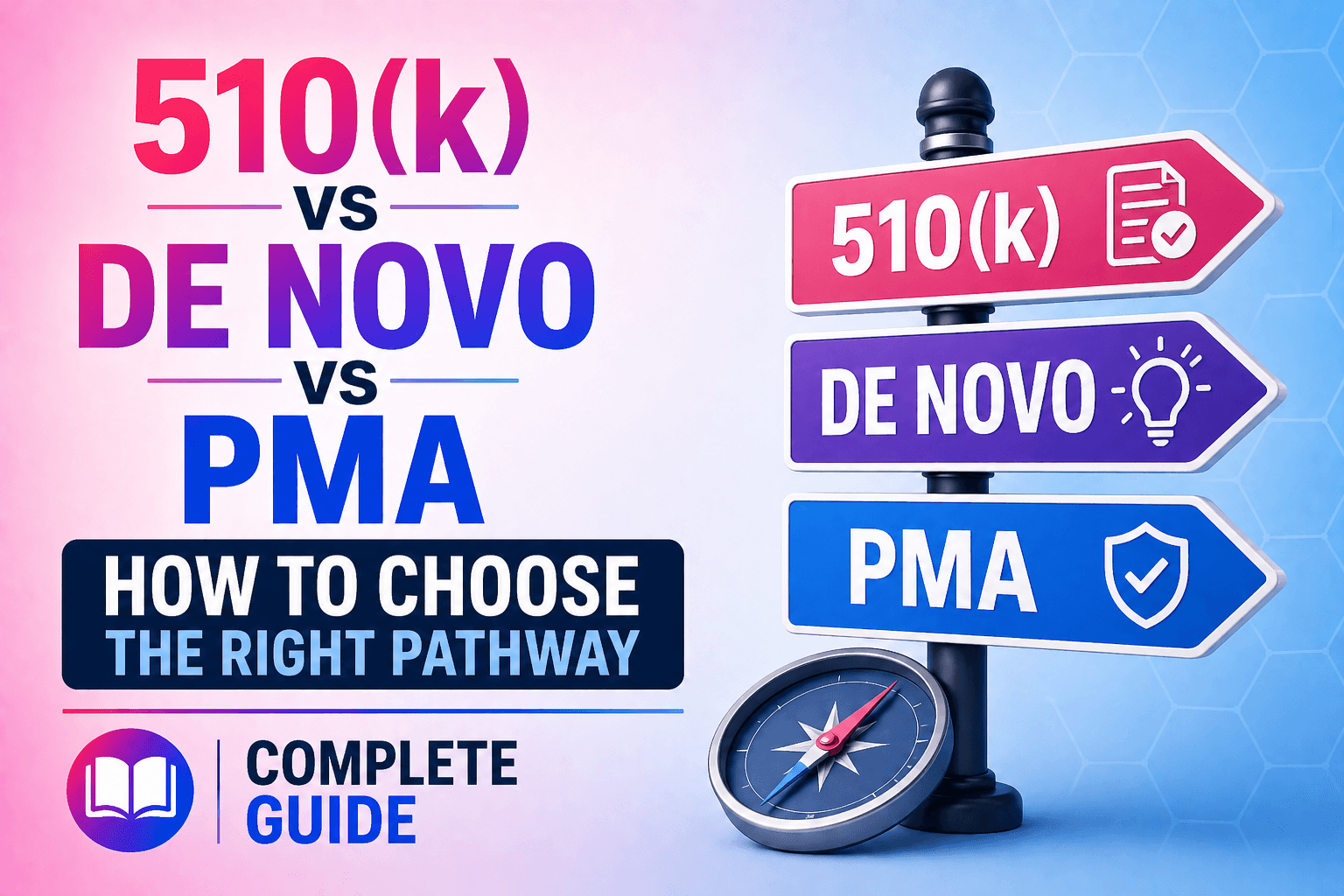
Quick Answer: Choosing an FDA pathway hinges on risk, novelty, and predicates. Use 510(k) when a suitable predicate exists for the same intended use and technology (typically Class II). Choose De Novo for novel, low-to-moderate-risk devices without a predicate—this creates a new classification. Use PMA for Class III, high-risk or life-supporting devices requiring proof of safety and effectiveness.
Before diving into details, use this quick decision tree:
Step 1: What's your device risk level?
- Low-Moderate risk: 510(k) or De Novo
- High risk (Class III): PMA
Step 2: Do similar devices exist on the market?
- Yes, with same intended use: 510(k) likely
- Yes, but different use/tech: Consider De Novo
- No comparable devices: De Novo or PMA
Step 3: What's your timeline reality?
- Need market in 6-12 months: 510(k) only
- Can wait 12-18 months: De Novo viable
- Multi-year timeline OK: PMA possible
When to Choose 510(k): The Speed Play
Choose 510(k) when:
- Clear predicate device exists with same intended use
- Speed to market is critical
- Limited regulatory budget
- Technology is incremental improvement
The Catch: Substantial equivalence is harder than it looks. "Similar" doesn't mean "equivalent." Your device must have the same intended use and either identical tech characteristics or different ones that don't raise new safety questions.
Quick Test: Can you write a one-sentence comparison showing your device does the same thing, the same way, as an existing cleared device? If not, 510(k) might not work.
→ Learn more: [What Is a 510(k)? A Plain-English Overview for 2025]
When to Choose De Novo: The Innovation Route
Choose De Novo when:
- No adequate predicate exists
- Device is clearly low-moderate risk
- You can define reasonable safety controls
- You want to establish the regulatory precedent
The Advantage: You're writing the rules competitors must follow. Once cleared, your device becomes the predicate for future 510(k)s.
The Risk: FDA might classify your device as Class III, forcing PMA route. Strong risk analysis is essential.
→ Learn more: [De Novo, Decoded: FDA's "Middle-Way" Pathway]
When to Choose PMA: The High-Stakes Pathway
Choose PMA when:
- Device is Class III (life-sustaining/high risk)
- Significant clinical evidence needed
- Multi-million dollar development budget available
- Market opportunity justifies investment
The Reality: PMA isn't just device approval—it's approval of your entire system including manufacturing, quality controls, and post-market surveillance.
The Payoff: Highest regulatory barriers create strongest competitive moats.
→ Learn more: [PMA Explained: When Do You Need One and Why?]
2026 Special Considerations
AI/ML Devices
New January 2025 guidance affects pathway selection:
- Predefined algorithms: Traditional pathways apply
- Adaptive algorithms: Likely De Novo with change control plan
- Continuously learning: May need novel approach
Cybersecurity Requirements
All connected devices need cybersecurity documentation, but depth varies by pathway.
Combination Products
New guidance adds complexity—pathway depends on primary mode of action.
The Key Mistakes to Avoid
Mistake #1: Wrong Predicate Selection
Problem: Choosing predicate that's too old, too different, or cleared under different standards
Solution: Research predicates from last 5 years with identical intended use
Mistake #2: Overestimating Substantial Equivalence
Problem: Assuming "similar performance" equals substantial equivalence
Solution: Focus on technological characteristics, not marketing benefits
Mistake #3: Underestimating De Novo Complexity
Problem: Thinking De Novo is "easier 510(k)"
Solution: Prepare for clinical studies and novel testing requirements
Mistake #4: PMA Without Strategy
Problem: Filing PMA without understanding full requirements
Solution: Extensive pre-submission meetings and regulatory planning
Your Next Steps
The right pathway decision sets everything else in motion. Use this framework to make an informed choice, but remember: when in doubt, invest in expert guidance or FDA pre-submission meetings.
Quick Action Items:
- Use our decision checklist to evaluate your device
- Research predicates thoroughly before assuming 510(k) route
- Consider pre-submission meetings for complex decisions
- Budget realistically using our cost estimates
The Fastest Path to Market
Frequently Asked Questions
What happens if I choose the wrong pathway?
If you file 510(k) and get "not substantially equivalent," you can file De Novo within 30 days. If you file De Novo and FDA finds an adequate predicate, they may suggest 510(k). Neither scenario is catastrophic.
How accurate are these timelines?
FDA's official timelines are review periods only. Add 3-6 months for preparation and expect at least one response cycle. Our estimates include realistic total time from decision to clearance.
Should I use pre-submission meetings?
For complex devices or pathway uncertainty, yes. Use them for De Novo and PMA especially.
Can I change pathways mid-review?
Yes, by withdrawing and refiling, but you start over completely. Plan for this possibility early in development.
What's the most common pathway mistake?
Overestimating substantial equivalence for 510(k). Many devices that seem "similar" have fundamental differences that prevent substantial equivalence.