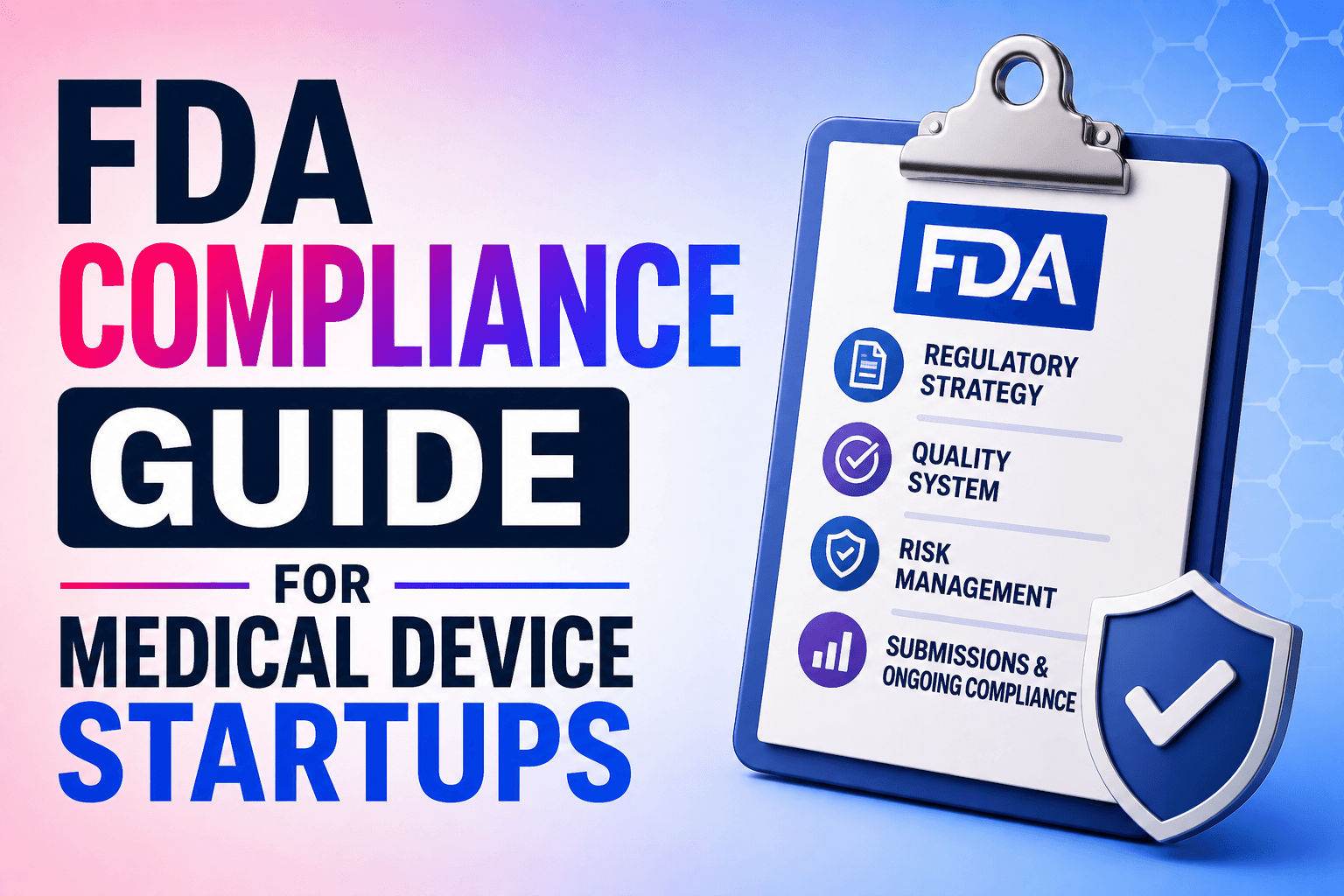
Startups can meet FDA requirements without burning runway by sequencing the right decisions in the right order. This guide shows how to define intended use, choose class and product code, pick the pathway, map claims to evidence, stand up a lean quality system, plan testing and submissions, register and list, label with UDI, and set postmarket workflows.
Why FDA Compliance is Essential for Medical Device Startups
FDA compliance is essential for any company aiming to sell medical devices in the U.S. market. The FDA’s regulations are designed to protect patients by ensuring that medical devices are safe and effective. Compliance can help small companies avoid costly recalls, maintain product quality, and build trust with customers. Without meeting FDA standards, small companies may struggle to compete or even launch their products.
However, achieving compliance is not without its challenges, especially for smaller firms with limited resources.
Unique Challenges Faced by Small Medical Device Companies
- Testing and Validation: Required to prove a device’s safety, testing can cost tens of thousands of dollars.
- Required to prove a device’s safety, testing can cost tens of thousands of dollars.
- Submission Fees: FDA submission pathways like 510(k) or Premarket Approval (PMA) have fees ranging from $5,000 to over $300,000, depending on the device.
- FDA submission pathways like 510(k) or Premarket Approval (PMA) have fees ranging from $5,000 to over $300,000, depending on the device.
- Consulting Fees: Without an in-house compliance expert, startups often need consultants, which can significantly increase costs.
- Without an in-house compliance expert, startups often need consultants, which can significantly increase costs.
- Ongoing Monitoring: After approval, the FDA mandates ongoing reporting and annual registration, which add to long-term compliance costs.
- After approval, the FDA mandates ongoing reporting and annual registration, which add to long-term compliance costs.
Limited Financial Resources
- Misinterpreting FDA Classifications: Devices are classified by risk (Class I, II, or III), each with unique requirements. Choosing the wrong pathway can lead to costly rework.
- Devices are classified by risk (Class I, II, or III), each with unique requirements. Choosing the wrong pathway can lead to costly rework.
- Extensive Documentation: FDA submissions require detailed reports on testing, design, and risk. Missing elements can lead to submission rejections and delays.
- FDA submissions require detailed reports on testing, design, and risk. Missing elements can lead to submission rejections and delays.
- Keeping Up with Regulatory Changes: The FDA updates its regulations frequently, and startups without dedicated resources may miss critical updates.
- The FDA updates its regulations frequently, and startups without dedicated resources may miss critical updates.
Regulatory Knowledge Gaps
- Limited Access to Compliance Tools and Technology
Limited Access to Compliance Tools and Technology
Larger companies often use advanced tools for document management, regulatory tracking, and submission organization, but these can be costly. Startups may have to rely on manual processes, which are more error-prone and time-consuming.
Challenges without these tools include:
- Without a system for tracking document revisions and approvals, startups risk losing important updates.
- Manual processes are harder to track, increasing the likelihood of missing deadlines or documentation requirements.
- Relying on spreadsheets or simple databases slows down workflows, taking time away from other essential business functions.
For startups, lack of access to these tools adds an additional burden to already tight resources.
Breaking Down FDA Compliance Costs for Startups
Understanding compliance costs is essential for startups to budget effectively. Here’s a breakdown of typical expenses:
- To prove device safety, the FDA requires extensive testing, which can cost from thousands to tens of thousands of dollars.
- The fee depends on the pathway (510(k) or PMA) and can range from $5,000 for small business 510(k) to $300,000+ for PMA submissions.
- Many startups hire regulatory consultants to navigate the process, which can cost between $10,000 and $100,000 depending on the complexity.
- FDA mandates ongoing monitoring, which includes incident reporting and annual registration fees.
Budgeting for these costs helps startups prepare without compromising on essential areas like product development.
Steps to Help Startups Navigate FDA Compliance
- Use Third-Party Consultants and Free Resources When in-house expertise is limited, hiring regulatory consultants can be an effective solution. Consultants guide startups through complex submission pathways, ensure that documentation meets FDA standards, and provide insights into navigating regulatory changes. While consultants add costs, their expertise can save time and prevent costly mistakes in submissions. Complizen also supports startups by connecting them with experienced regulatory professionals. Through its network of experts, startups can access guidance tailored to their device, regulatory pathway, and compliance needs—all at a fraction of the cost of hiring a full-time consultant.
Use Third-Party Consultants and Free Resources
- Leverage Affordable Compliance Tools
Leverage Affordable Compliance Tools
Cost-effective tools and resources can simplify compliance tasks for startups. Some helpful resources include:
- The FDA offers free guidance documents to help companies understand specific requirements and regulatory standards.
- Complizen provides an affordable, accessible platform that organizes compliance documents, tracks regulatory updates, and offers submission support tailored for startups. By centralizing compliance tasks, Complizen ensures startups have all their regulatory needs in one place, making compliance more manageable and reducing the risk of errors.
- These FDA databases allow startups to view similar products, providing valuable insights into requirements for specific device types.
By using Complizen’s platform alongside these resources, startups can streamline compliance on a budget, allowing their team to focus on product innovation and growth.
Conclusion
Small medical device companies face unique challenges in navigating FDA compliance, from high costs and regulatory knowledge gaps to complex submission requirements. However, with proactive strategies—such as leveraging third-party expertise, using affordable compliance tools, and platforms like Complizen—small companies can effectively meet FDA standards, minimize compliance risks, and bring their innovations to market.
By addressing these compliance challenges early on, small medical device companies can build a strong foundation for long-term success.
The Fastest Path to Market
FAQs
- Why is FDA compliance especially challenging for small medical device companies?Small companies often lack the resources, expertise, and access to compliance tools that larger companies have, making it more difficult to manage FDA requirements effectively.
- How much does FDA compliance typically cost for small companies?Compliance costs vary but can include fees for testing, submission, consulting, and post-market surveillance, totaling thousands to tens of thousands of dollars depending on the device and regulatory pathway.
- What are some common compliance mistakes made by small companies?Common mistakes include inadequate documentation, misinterpreting device classifications, and overlooking FDA’s reporting requirements, all of which can lead to delays or submission rejections.
- How can small companies access regulatory expertise if they can’t afford a full team?Many small companies turn to regulatory consultants or platforms like Complizen that provide affordable access to compliance experts and tools to fill knowledge gaps.
- How does Complizen support FDA compliance for small companies?Complizen offers compliance tools and expert support designed specifically for small companies, simplifying document management, regulatory tracking, and the 510(k) and PMA submission processes.