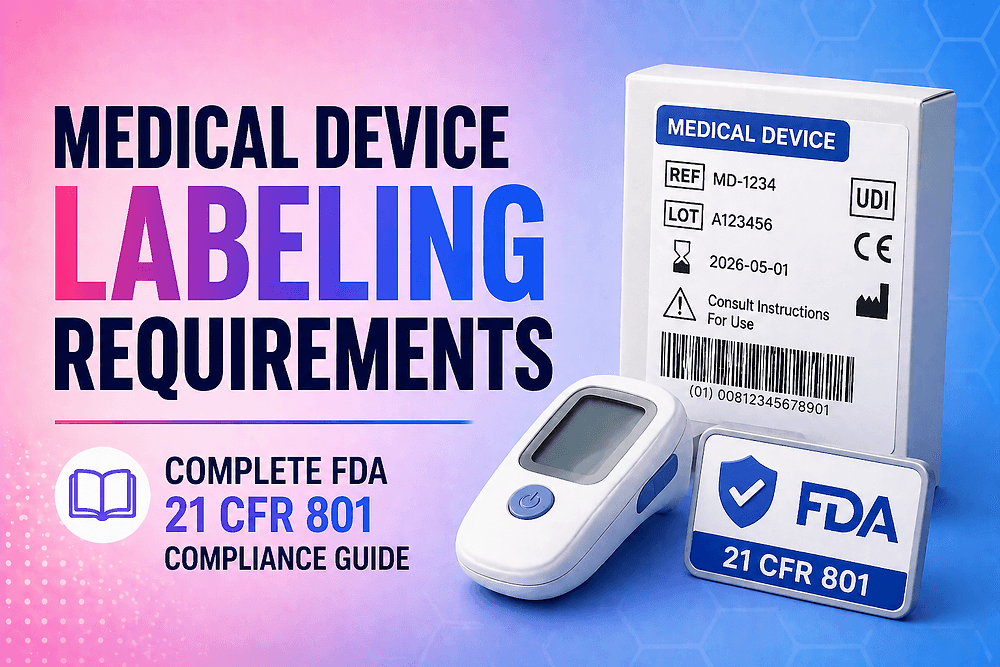
FDA requires medical device labeling to include manufacturer information, intended use, adequate directions, warnings, UDI (where applicable), and device-specific requirements. Labeling encompasses all written materials including labels, packaging, instructions for use, and promotional materials. Compliance requires both content accuracy and quality system controls under 21 CFR 820.120.
This guide covers all FDA labeling requirements, common violations, and compliance strategies to prevent enforcement actions.
What FDA Considers "Medical Device Labeling"
The biggest mistake companies make is thinking labeling only refers to the physical label on their device. FDA defines medical device labeling much more broadly, encompassing virtually all written communications about your device.
FDA's Comprehensive Labeling Definition
Under 21 CFR Part 801, medical device labeling includes all labels and other written, printed, or graphic matter:
On or Accompanying the Device:
- Physical device labels and stickers
- Packaging and shipping containers
- Instructions for use (IFU) and user manuals
- Package inserts and product information sheets
- Software interfaces and electronic displays
Promotional and Educational Materials:
- Marketing brochures and sales literature
- Website content and digital materials
- Training materials and educational content
- Technical specifications and white papers
Critical FDA Position: According to an appellate court decision: "Most, if not all advertising, is labeling. The term 'labeling' is defined in the FFDCA as including all printed matter accompanying any article."
The Business Impact of This Broad Definition
Compliance Scope: Every piece of written material about your device must comply with FDA labeling regulations, not just the physical product label.
Enforcement Risk: FDA routinely cites companies for labeling violations in promotional materials, websites, and training documents that contradict approved labeling.
Quality System Integration: All labeling materials must be controlled under your Quality Management System per 21 CFR 820.120.
Core FDA Labeling Requirements: 21 CFR Part 801
All medical devices distributed in the United States must comply with general labeling requirements under 21 CFR Part 801, regardless of classification or regulatory pathway.
Mandatory Label Content
Manufacturer Information (21 CFR 801.1): The label must contain the name and place of business of manufacturer, packer, or distributor including street address, city, state, and zip code. If the firm's street address is in the local telephone directory, the street address can be omitted.
Qualification Statements: If the firm listed on the label is not the manufacturer, the firm information must be qualified by an appropriate statement such as "Manufactured for..." or "Distributed by..."
Adequate Directions for Use (21 CFR 801.5)
FDA Definition: "Adequate directions for use" means directions under which the layman can use a device safely and for the purposes intended.
Required Content:
- Statements of all purposes for which and conditions under which the device can be used
- Quantity of dose for each use and usual quantities for persons of different ages and physical conditions
- Frequency and duration of use
- Time of administration or application
- Route or method of administration or application
- Any preparation necessary for use
Professional Use Exemption: Devices restricted to prescription use are exempt from adequate directions requirements when used by qualified practitioners.
Warnings and Contraindications
Mandatory Warning Statements:
- All foreseeable risks and safety information
- Contraindications for specific patient populations
- Proper storage and handling instructions
- Expiration date information where applicable
Format Requirements: Warnings must be prominently displayed and clearly distinguishable from other labeling content through font size, contrast, or positioning.
Unique Device Identification (UDI) Requirements
The UDI system under 21 CFR Part 801 Subpart B and 21 CFR Part 830 represents one of FDA's most significant labeling requirements, affecting most medical devices.
UDI ComplianceRequirements
General Rule (21 CFR 801.20): The label of every medical device and package shall bear a unique device identifier (UDI) that meets the requirements of this subpart and part 830 of this chapter.
UDI Components:
- Device Identifier (DI): Mandatory, fixed portion identifying the specific version/model and labeler
- Production Identifier (PI): Conditional, variable portion identifying lot number, serial number, expiration date, and/or manufacturing date
UDI Exemptions
Devices Exempt from UDI Requirements:
- Class I devices exempt from Good Manufacturing Practice requirements (21 CFR Part 820), except recordkeeping and complaint files
- Custom devices within the meaning of 21 CFR 812.3(b)
- Investigational devices under Part 812
- Devices intended for export from the United States
- Devices used solely for research, teaching, or chemical analysis
- Pre-compliance inventory
- Individual single-use items within a multi-pack (package still needs UDI)
- Veterinary-only devices
- Combo products/conv. kits nuances
- Shipping containers
- Class I UDI needn’t include PI
Compliance Timeline: UDI requirements are phased by device class with specific compliance dates. Devices manufactured and labeled prior to compliance dates have a 3-year grace period.
GUDID Database Submission
Global Unique Device Identification Database (GUDID): Device labelers must submit device information to FDA's GUDID database, including device description, intended use, and labeling information.
Submission Requirements:
- Submit before first commercial distribution
- Update within 60 days of any changes
- Maintain accurate device status information
Quality System Labeling Controls: 21 CFR 820.120
FDA requires comprehensive quality system controls for all labeling activities under the Quality System Regulation.
Labeling Control Requirements
Control Procedure (21 CFR 820.120): Each manufacturer must establish and maintain procedures to control labeling activities, ensuring correct labeling is issued and used for each device.
Five Critical Control Areas:
1. Labeling Integrity:
- Labels must remain affixed to the device throughout distribution and use
- Labeling must remain legible under customary conditions of processing, storage, handling, distribution, and use
- Specifications must address substrate, dimensions, ink, finish, and mounting methods
2. Labeling Storage:
- Implement systems ensuring correct labels are applied to corresponding devices
- Prevent mix-ups through proper storage and identification procedures
- Control access to labeling materials and storage areas
3. Labeling Inspection:
- Inspect incoming labeling materials per 21 CFR 820.80(b)
- Verify labeling accuracy and quality before use
- Document inspection results and corrective actions
4. Labeling Operations:
- Control labeling application processes
- Train personnel on proper labeling procedures
- Implement verification checks during labeling operations
5. Labeling Documentation:
- Maintain device master records including labeling specifications
- Document labeling changes and approvals
- Ensure traceability from design inputs to final labeling
Common Quality System Labeling Violations
FDA 483 Observations:
- Inadequate labeling control procedures
- Label mix-ups due to improper storage
- Missing or incorrect labeling inspections
- Insufficient documentation of labeling changes
- Lack of training on labeling procedures
Device-Specific Labeling Requirements
Beyond general requirements, many devices have additional labeling obligations based on classification, intended use, or regulatory pathway.
Prescription Device Labeling
Rx-Only Statement: Prescription devices must include "Caution: Federal law restricts this device to sale by or on the order of a physician" or equivalent statement.
Professional Labeling:
- Detailed instructions for healthcare providers
- Clinical performance data
- Contraindications and warnings
- Adverse event information
Over-the-Counter (OTC) Device Labeling
Consumer-Friendly Instructions:
- Simple, clear directions for lay users
- Step-by-step usage instructions
- Safety warnings in plain language
- Storage and maintenance information
Sterile Device Labeling
Sterility Information:
- Sterilization method identification
- Sterile barrier system integrity indicators
- Storage conditions maintaining sterility
- Single-use designations where applicable
Software and Digital Device Labeling
Electronic Labeling Provisions: FDA allows electronic labeling for prescription devices used in healthcare facilities under specific conditions, reducing paper-based labeling requirements.
Software Interface Requirements:
- User interface elements providing instructions, warnings, or device identification
- Software version identification
- Cybersecurity information and instructions
Symbol Usage in Medical Device Labeling
FDA regulations under 21 CFR 801.15 govern the use of symbols in medical device labeling, balancing international harmonization with safety requirements.
Stand-Alone Symbol Requirements
2016 Final Rule Changes: FDA now allows stand-alone symbols (without adjacent explanatory text) if certain requirements are met:
Acceptable Symbol Standards:
- Symbols established in standards developed by recognized Standards Development Organizations (SDOs)
- FDA has recognized the standard or portion containing the symbol
- Symbol is used according to FDA recognition specifications
Required Information: Provide a symbols glossary in the labeling (paper or electronic) and place a prominent statement on/in the package identifying the glossary’s location.
Common Medical Device Symbols
Internationally Recognized Symbols:
- Sterilization method indicators
- Temperature and storage condition symbols
- Single-use and reusable device indicators
- Manufacturer and date of manufacture symbols
Language and Translation Requirements
FDA has specific requirements for foreign language labeling and translation accuracy.
English Language Requirements
General Rule (21 CFR 801.15): All labeling shall be in English, except for products distributed solely within Puerto Rico or U.S. territories where the predominant language is other than English.
Foreign Language Additions: If any representation on the device label or labeling appears in a foreign language, then all required labeling shall also appear in that foreign language. For Rx-only devices sold solely in Puerto Rico, Spanish-only labeling is allowed.
Translation Accuracy Standards
FDA Expectations:
- Accurate translation of all required elements
- Cultural appropriateness for target populations
- Consistency across all labeling materials
- Regular review and updates of translated content
Regulatory Submission Labeling Requirements
Labeling plays a critical role in FDA regulatory submissions and must be properly prepared for review.
510(k) SubmissionLabeling
Required Elements:
- Draft labels meeting all applicable requirements
- Instructions for use demonstrating safe and effective use
- Promotional materials and advertising claims
- Comparison to predicate device labeling
FDA Review Focus:
- Consistency with intended use and indications
- Adequacy of warnings and contraindications
- Compliance with general and specific labeling requirements
- Support for substantial equivalence claims
PMA SubmissionLabeling
Comprehensive Labeling Package:
- Complete labeling including all patient and provider materials
- Clinical data supporting labeling claims
- Risk-benefit analysis reflected in labeling
- Post-market study commitments
Labeling Changes Post-Approval
Change Control Requirements: For 510(k) devices, apply Deciding When to Submit a 510(k) for a Change to an Existing Device (see Labeling Changes flowchart). For PMA devices, see 814.39 to determine supplement type.
Significant Changes Requiring New Submission:
- New indications for use
- New patient populations
- Significant safety warnings
- Major use instruction modifications
Common Labeling Violations and How to Avoid Them
Top FDA 483 Labeling Citations
Label Mix-ups and Storage Issues:
- Implementing inadequate labeling storage systems
- Failing to prevent similar labels from being confused
- Insufficient access controls to labeling areas
Prevention Strategy:
- Color-coding systems for different product lines
- Barcode verification for label application
- Segregated storage with clear identification
- Regular audits of labeling storage areas
Missing Required Information:
- Omitting UDI when required
- Incorrect or missing manufacturer information
- Inadequate directions for use
- Missing expiration dates or lot numbers
Prevention Strategy:
- Comprehensive labeling checklists for each device
- Multiple review stages before labeling approval
- Regular training on labeling requirements
- Automated systems for required information inclusion
Promotional Material Violations
Off-Label Claims:
- Promoting uses not included in FDA clearance/approval
- Making unsubstantiated performance claims
- Comparing to devices outside approved indications
Prevention Strategy:
- Legal and regulatory review of all promotional materials
- Clear procedures for sales team training
- Regular monitoring of marketing communications
- Documentation of approved promotional claims
Inconsistent Information:
- Contradictions between different labeling materials
- Website content conflicting with approved labeling
- Training materials containing unapproved information
Prevention Strategy:
- Single source of truth for all labeling content
- Version control systems for labeling materials
- Regular updates across all platforms and materials
- Cross-functional review processes
Implementation Best Practices
Labeling Development Process
Phase 1: Requirements Analysis
- Identify all applicable FDA requirements
- Determine device-specific labeling needs
- Analyze user requirements and use environments
- Review predicate device labeling (for 510(k) devices)
Phase 2: Content Development
- Create comprehensive labeling content
- Ensure consistency across all materials
- Include required warnings and contraindications
- Develop user-friendly instructions
Phase 3: Review and Approval
- Internal cross-functional review
- Legal and regulatory approval
- Clinical review for accuracy
- Final management approval
Phase 4: Quality System Integration
- Implement labeling control procedures
- Train personnel on labeling requirements
- Establish change control processes
- Create documentation systems
Global Labeling Strategy
Harmonization Opportunities:
- Leverage international symbol standards
- Align with global regulatory requirements where possible
- Consider translation requirements early in development
- Plan for multiple market labeling needs
Regional Considerations:
- EU MDR labeling requirements for European markets
- Health Canada specific labeling needs
- Other international market requirements
- Cultural and linguistic considerations
The Fastest Path to Market
No more guesswork. Move from research to a defendable FDA strategy, faster. Backed by FDA sources. Teams report 12 hours saved weekly.
Frequently Asked Questions
Do I need UDI on my Class I device?
Most Class I devices exempt from GMP requirements under 21 CFR Part 820 don't require UDI. However, check the specific exemption list as some Class I devices do require UDI.
Can I use electronic labeling instead of paper instructions?
FDA allows electronic labeling for prescription devices used in healthcare facilities under specific conditions outlined in guidance documents. OTC devices generally require paper labeling.
What labeling changes require a new 510(k)?
Significant labeling changes affecting safety, effectiveness, or intended use typically require new 510(k) submissions. Minor corrections or clarifications may not require new submissions.
How do I handle labeling for combination products?
Combination products have complex labeling requirements depending on the lead center assignment. Early FDA interaction through pre-submission meetings is recommended.
What are the penalties for labeling violations?
Penalties range from FDA 483 observations and warning letters to product recalls, consent decrees, and criminal prosecution for willful violations.