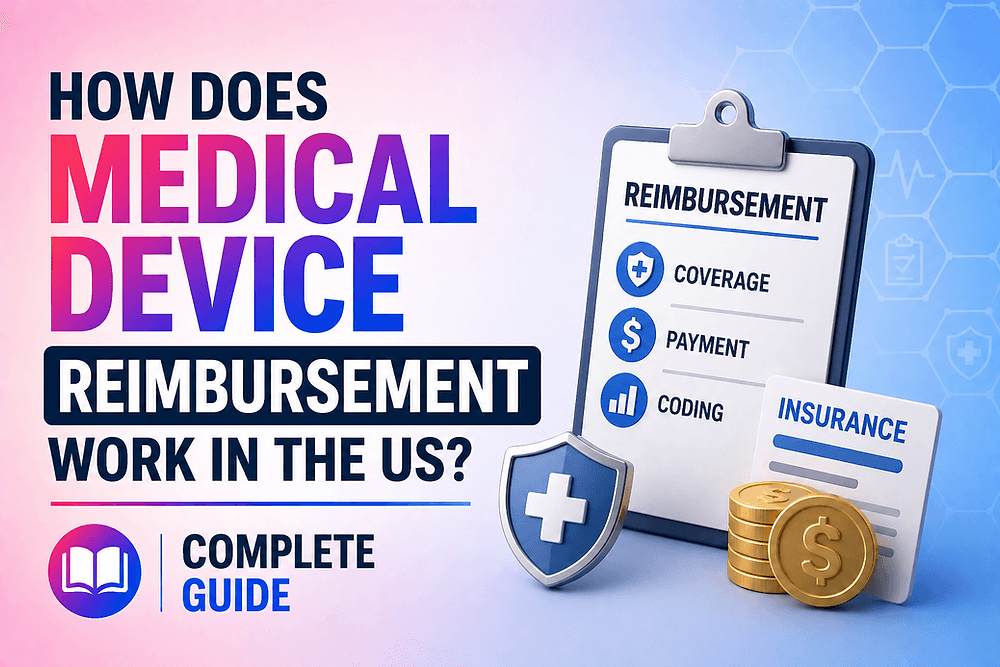
In the US, reimbursement for medical devices rests on three pillars: coding, coverage, and payment. Coding assigns CPT/HCPCS and, when relevant, ICD-10-PCS/MS-DRG. Coverage comes from Medicare NCDs/LCDs and commercial payer policies. Payment is set through MS-DRGs for inpatient care, APCs for hospital outpatient, the Physician Fee Schedule for professional services, and DMEPOS rates for supplies. This guide shows how to plan evidence and align regulatory with HEOR to win adoption.
Why Reimbursement Determines Your Device's Success or Failure
Reimbursement is the process where third-party payers (Medicare, Medicaid, commercial insurers) compensate healthcare providers for medical devices and associated procedures.
Without adequate reimbursement, even FDA-approved devices fail commercially because hospitals and physicians cannot afford to use them.
The stark reality: Getting FDA approval does not guarantee market success. If your device doesn't obtain desired reimbursement amounts or coverage by payers, physicians and hospitals will not adopt your technology, regardless of its clinical benefits.
Timeline urgency is critical. Research shows an average delay of 4.7 years from FDA approval to CMS reimbursement, and the entire new CPT code application process can take from 18 to 24 months, with evidence collection requiring two to five years. Starting reimbursement planning after FDA approval means years of delayed market access.
The Three Pillars of Medical Device Reimbursement
1. Coding: The Language That Enables Payment
What it is: Standardized alphanumeric codes that describe medical devices, procedures, and services
Why it matters: Because medical device reimbursement primarily depends on the coding system, the absence of the correct code may prevent payment for a device or service
Key coding systems:
- CPT codes: Describe medical procedures and services performed by physicians
- HCPCS codes: Cover medical services, devices, and supplies not in CPT
- ICD codes: Identify diagnoses and medical justification for procedures
2. Coverage: Will Payers Pay for Your Device?
What it is: The decision by insurers whether they will reimburse providers for your device/procedure
Critical factors:
- FDA approval or clearance (mandatory baseline)
- Clinical evidence demonstrating safety and efficacy
- Medical necessity determination
- Not deemed "experimental" or "investigational"
Coverage variation reality: Blue Cross Blue Shield of South Carolina may cover a newly approved medical device/service while Blue Cross Blue Shield of California denies coverage
3. Payment: The Amount That Determines Adoption
What it is: The actual dollar amount payers reimburse providers
Business impact: If you price your implant at $8,000 and payers reimburse at $10,000, it's unlikely hospitals will adopt the technology because the balance will only cover a small portion of the remaining costs
Payment mechanisms vary by care setting:
- Outpatient: Separate payment for device outside procedure payment
- Inpatient: Device cost bundled into DRG payment
- Home use: DMEPOS competitive bidding may apply
Existing vs. New CPT Code Strategy: The Critical Decision
When Existing Codes Work for You
Best scenario: Your device fits existing CPT codes with adequate payment levels
Advantages:
- Immediate billing capability upon FDA approval
- Established payment rates providers understand
- No lengthy code application process
Strategic consideration: Just because a product is innovative does not mean that it cannot fit into an existing CPT code. CPT codes that define the outcome as opposed to the process are particularly relevant
When You Need New CPT Codes
Indicators you need new codes:
- No existing code adequately describes your device's unique value
- Existing codes provide inadequate payment levels
- Your device enables fundamentally new procedures
Application requirements include:
- Complete procedure description with skill and time involved
- Clinical vignette describing typical patient and procedure
- Publications in U.S. peer-reviewed journals demonstrating safety and effectiveness
- Evidence of FDA approval for the device
- Frequency data showing appropriate utilization
Timeline reality: The AMA releases the new CPT book, including annual updated new codes, in the fall of each year to allow effective use on January 1 for most category I codes
Category III Codes: The Temporary Solution
What they are: Temporary codes for emerging technologies while building evidence for permanent Category I codes
Pros: Faster application process, allows claim submission
Cons: No set payment fee will be established, and it can take years to transition to a category I code. Furthermore, companies run the risk that their device or procedure will be labelled experimental
Medicare vs. Commercial Payer Strategies
Medicare (CMS) Pathway
National Coverage Determinations (NCDs):
- Advantage: Nationwide Medicare coverage if approved
- Risk: If CMS issues a non-coverage NCD you can request a reconsideration—but only after gathering stronger clinical-utility data.
- Evidence requirements: Typically higher than FDA requirements
Local Coverage Determinations (LCDs):
- Advantage: Can apply to multiple Medicare Administrative Contractors (MACs)
- Flexibility: A negative coverage determination by any one MAC can be appealed and does not prevent the manufacturer from applying for coverage from other MACs
New Technology Add-On Payments: CMS provides companies with the option of applying for a New Technology Add-on Payment, which now reimburses up to 65 % of incremental inpatient cost (75 % for certain QIDP/CGT products).
Commercial Payer Strategy
Key players: Blue Cross Blue Shield plans, Aetna, Cigna, United Healthcare, Kaiser
Coverage approach: Each payer makes independent coverage decisions
Timeline advantage: Often faster than Medicare coverage decisions
Evidence requirements: Vary by payer but generally focus on clinical effectiveness and economic value
When to Start Reimbursement Planning: Timeline Integration
Phase 1: Concept Development (Year -5 to -4)
Reimbursement activities:
- Assess existing reimbursement landscape for similar devices
- Identify potential CPT codes and payment levels
- Evaluate economic value proposition vs. existing alternatives
- Integrate reimbursement considerations into device design
Critical insight: A Startup medical device company should initiate reimbursement planning in parallel to developing the regulatory strategy
Phase 2: Early Development (Year -4 to -3)
Key activities:
- Design clinical trials to generate both regulatory and reimbursement evidence
- Engage with FDA's Early Payor Feedback Program if eligible
- Begin health economics evidence planning
- Identify medical specialty societies for CPT code support
Phase 3: Clinical Trials (Year -3 to -1)
Reimbursement focus:
- Collect health economics data during clinical trials
- Generate real-world evidence for payer value demonstrations
- Engage with payers through FDA Parallel Review Program
- Develop preliminary value story and economic models
Phase 4: Pre-Market Preparation (Year -1 to 0)
Critical activities:
- Submit CPT code applications (if needed) 18-24 months before launch
- Prepare Medicare coverage determination strategy
- Begin commercial payer engagement
- Develop billing guides and provider training materials
Phase 5: Post-Market Evidence (Year 0+)
Ongoing activities:
- Generate real-world data to support coverage decisions
- Monitor payer policies and payment adequacy
- Expand coverage to additional payers
- Optimize health economics evidence
Health Economics Evidence: What Payers Really Want
Clinical Evidence Requirements
Beyond FDA approval: The scope of clinical evidence required by payers often exceeds FDA requirements, which focus on the device's safety and efficacy
Key evidence types:
- Comparative effectiveness: How your device performs vs. existing alternatives
- Real-world outcomes: Post-market surveillance data showing actual patient benefit
- Safety profile: Long-term adverse event data
- Quality of life impacts: Patient-reported outcomes measures
Economic Evidence Essentials
Budget impact analysis: How your device affects overall healthcare spending
Cost-effectiveness studies: Cost per quality-adjusted life year (QALY) or other outcome measures
Value-based care alignment: Evidence supporting value-based payment models
Resource utilization: Impact on hospital length of stay, readmissions, complications
Strategic insight: By considering reimbursement criteria early on, developers can align their clinical trial design, data collection, and economic modeling to generate the evidence required for successful reimbursement decisions
Commercial Payer Engagement Strategy
Understanding Payer Decision-Making
Technology assessment committees: Review clinical and economic evidence
Medical directors: Evaluate medical necessity and appropriateness
Actuaries: Assess budget impact and cost-effectiveness
Pharmacy and therapeutics committees: For combination products with drug components
Payer Engagement Timeline
Pre-submission (18+ months before launch):
- Share clinical trial designs for payer input
- Discuss evidence requirements and endpoints
- Understand coverage policies for similar devices
Submission phase (6-12 months before launch):
- Submit formal coverage requests with complete dossiers
- Present to technology assessment committees
- Address payer questions and evidence gaps
Post-decision follow-up:
- Monitor real-world utilization and outcomes
- Provide additional evidence as requested
- Expand coverage to additional payer segments
Common Reimbursement Mistakes That Kill Market Access
Mistake 1: Starting Too Late
The problem: Most manufacturers wait until they launch their product or are faced with resistance from Medicare before they begin to formulate a pathway toward reimbursement The cost: Years of delayed market access and lost revenue
The solution: Begin reimbursement planning during early development phases
Mistake 2: Assuming Innovation Equals Payment
The problem: Companies think that just because their technology is new it will automatically be reimbursed (or receive a higher level of reimbursement supporting their intended selling price)
Reality check: Many companies find out that they have a technology which will receive less than desirable reimbursement or worse yet, not be covered by insurance companies
Prevention: Conduct thorough reimbursement landscape analysis before finalizing device design
Mistake 3: Ignoring Care Setting Economics
The problem: Not understanding how payment varies by care setting (inpatient vs. outpatient vs. home)
Example: For medical devices administered in the inpatient care setting, reimbursement for the device is typically covered under a prospective DRG payment for all care associated with the inpatient stay
Solution: Analyze payment adequacy across all relevant care settings during development
Mistake 4: Inadequate Health Economics Evidence
The problem: Research has shown that about 30% of reimbursement claims are denied even though 63% of those claims should have been recoverable. The main cause for these denials is human error and missing data
Business impact: The cost resulting from these denials is approximately $8.6B in appeals-related administrative costs (or $118 per claim)
Prevention: Invest in robust clinical and economic evidence generation from early development
Mistake 5: Poor Payer Communication
The problem: Not engaging with payers early to understand their evidence requirements and decision criteria
Consequence: Misaligned clinical trials that don't generate payer-relevant evidence
Solution: Utilize FDA's Early Payor Feedback Program and conduct regular payer advisory boards
Step-by-Step Reimbursement Strategy Framework
Step 1: Reimbursement Landscape Analysis
Assess existing payment mechanisms:
- Identify applicable CPT/HCPCS codes and payment rates
- Analyze payment adequacy across care settings
- Map competitor reimbursement strategies
- Understand payer coverage policies for similar devices
Step 2: Evidence Strategy Development
Design integrated evidence generation:
- Align clinical trial endpoints with payer evidence requirements
- Plan health economics data collection
- Identify real-world evidence opportunities
- Develop comparative effectiveness study protocols
Step 3: Coding Strategy Implementation
For existing codes:
- Validate code applicability with medical specialty societies
- Assess payment adequacy vs. device costs
- Develop billing guidance for providers
For new codes:
- Engage medical specialty societies early
- Prepare comprehensive code change proposals
- Allow 18-24 months for application processing
- Consider Category III codes as interim solution
Step 4: Coverage Strategy Execution
Medicare approach:
- Decide between National vs. Local Coverage Determination strategy
- Prepare comprehensive evidence dossiers
- Engage CMS through appropriate channels
- Consider New Technology Add-On Payment applications
Commercial payer strategy:
- Prioritize payers by market share and member demographics
- Develop payer-specific value stories
- Submit formal coverage requests with supporting evidence
- Present to technology assessment committees
Step 5: Market Access Optimization
Provider support:
- Develop comprehensive billing guides
- Provide prior authorization support
- Train providers on optimal coding practices
- Monitor claims denials and appeals processes
Outcomes monitoring:
- Track real-world utilization and outcomes
- Generate additional evidence for payer presentations
- Expand coverage to additional payer segments
- Optimize pricing based on payment adequacy analysis
FDA Programs That Accelerate Reimbursement
Early Payor Feedback Program(EPFP)
Purpose: Connect device sponsors with payers prior to finalizing clinical trial plans
Benefit: Incorporates payer feedback in evidence generation strategy to support both market authorization and positive coverage determinations
Eligibility: Sponsors of devices that have not received FDA marketing authorization
Timeline: Allows alignment of regulatory and reimbursement evidence generation
Parallel Review Program
What it is: FDA and CMS simultaneously review clinical data for approval decision and national coverage determination
Advantage: Significantly reduces time between FDA approval and Medicare coverage
Requirements: Device must address public health needs of Medicare population
Application process: Contact Parallel-Review@fda.hhs.gov for participation
Medical Device Coverage Initiatives
Payor Communication Task Force: Facilitates communication between device manufacturers, payers, and others to potentially shorten time between FDA approval/clearance and patient access
Early engagement benefit: Data that medical device manufacturers submit to FDA to demonstrate safety and effectiveness may not always overlap with data needed by payers to make coverage determinations
International Reimbursement Considerations
European Union
Health Technology Assessment (HTA): EU-wide coordinated HTA process beginning 2025
National variations: Each member state maintains independent reimbursement decisions
Evidence requirements: Increasingly focused on real-world evidence and cost-effectiveness
Key Global Markets
Germany: G-BA assessment with evidence-based medicine focus
United Kingdom: NICE technology appraisals with QALY thresholds
Japan: Central Social Insurance Medical Council (Chuikyo) pricing decisions Canada: CADTH recommendations with provincial implementation
Strategic insight: Harmonizing market access efforts globally by streamlining the approval and coding processes can help mitigate regional disparities
Future of Medical Device Reimbursement
Value-Based Care Evolution
Trend: Increasing shift from fee-for-service to value-based payment models
Impact: Payers increasingly demand evidence of economic impact and patient outcomes
Preparation: Develop outcomes-based contracts and risk-sharing agreements
Real-World Data Integration
Growing importance: Real-world data playing crucial role in proving clinical and cost-effectiveness
Technology enablement: Connected devices providing automated reimbursement data collection
Strategic opportunity: Medical devices designed with automated reimbursement process can improve adoption and reduce claims denials
Digital Health Integration
Connected care model: IoMT creating increased manufacturer role in reimbursement process
Data advantages: Manufacturers have access to key information beyond that collected by traditional monitoring providers
Competitive advantage: Accurate measurement of device usage essential for Remote Patient Monitoring (RPM) and Remote Therapeutic Monitoring (RTM) CPT billing
The Fastest Path to Market
No more guesswork. Move from research to a defendable FDA strategy, faster. Backed by FDA sources. Teams report 12 hours saved weekly.
FAQ
Q: When should I start thinking about reimbursement for my medical device?
A: During concept development, ideally 4-5 years before market launch. Reimbursement considerations should inform device design and clinical trial planning from the beginning.
Q: Do I need a new CPT code for my innovative device?
A: Not necessarily. Many innovative devices can use existing CPT codes. The key is whether existing codes adequately describe your device and provide sufficient payment levels for provider adoption.
Q: What's the difference between Medicare and commercial payer coverage?
A: Medicare follows formal coverage determination processes (NCD/LCD) with public transparency. Commercial payers make independent coverage decisions with varying timelines and evidence requirements.
Q: How long does it take to get reimbursement coverage?
A: Variable by pathway: new CPT codes take 18-24 months, Medicare coverage 6-18 months, commercial payers 3-12 months each. Total time to broad coverage typically 2-5 years.
Q: What happens if payers deny coverage for my device?
A: Options include appeals processes, additional evidence generation, alternative coding strategies, or value-based contracting arrangements. Strategy depends on denial reasons.
Q: How much should I budget for reimbursement activities?
A: Plan for $1-3 million over 3-5 years for comprehensive reimbursement strategy including evidence generation, code applications, and payer engagement activities.