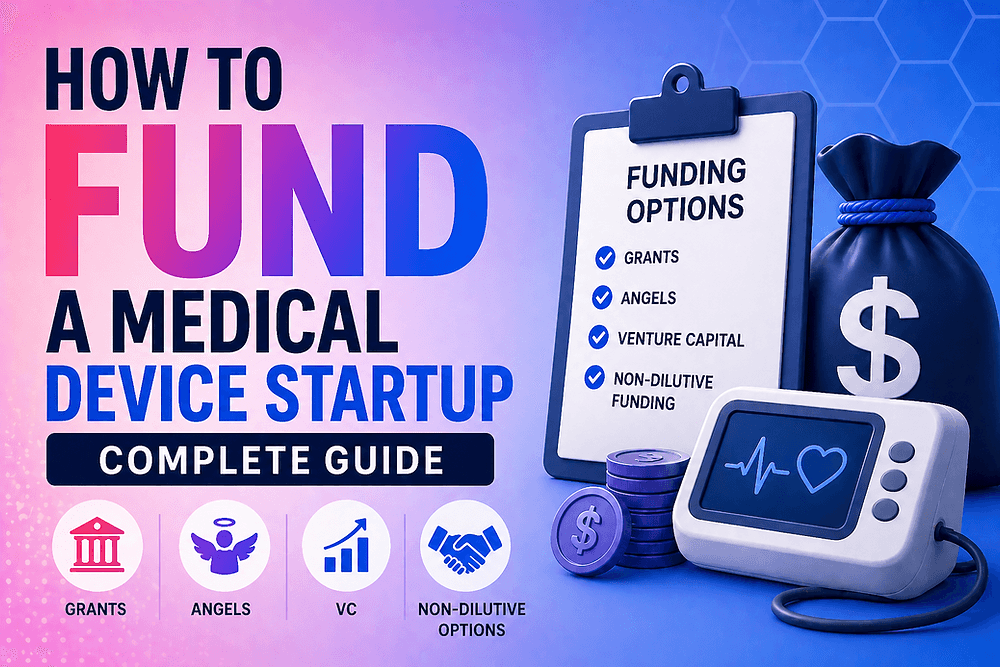
Quick Answer: Medical device startups have 8 primary funding sources: government grants ($305K-$3M, non-dilutive), angel investors ($50K-$2M, 10-25% equity), venture capital ($1M-$100M+, 15-30% equity per round), crowdfunding ($50K-$1M, variable terms), accelerators ($25K-$250K + mentorship), corporate partnerships, revenue-based financing, and bootstrapping. The smart play is sequencing: validate with grants, bridge with angels, then scale with venture—layering in partnerships or revenue-based financing when it fits your model.
This guide shows the main sources, realistic check sizes, and how to time each step for faster runway.
The Medical Device Funding Reality: Market Conditions
The healthcare funding landscape has fundamentally shifted. According to Rock Health, U.S. digital-health startups raised $10.3 B in H1 2022, down 30 % from $14.7 B in H1 2021, signalling a decisive post-pandemic reset.
The Good News: The health sector has held up better than other major industries. While SaaS funding decreased by 70.1% and fintech by 78.5%, the health sector shrank by only 44.1% since Q1 2022. The health sector's share of all venture capital invested has risen from 21% in 2018 to 32% in 2024.
What This Means for Founders: Capital is still flowing—but only to evidence-rich, milestone-ready medtechs. Investors are choosy, favouring startups that blend non-dilutive grants with staged equity to de-risk FDA and market-access milestones.
Complete Medical Device Funding Sources Breakdown
1. Government Grants: The $4.3B Non-Dilutive Foundation
Best For: Early-stage R&D, proof-of-concept, clinical validation
Government grants provide the strongest foundation because they're non-dilutive (you keep 100% equity) and offer regulatory credibility that attracts later investors.
Major Programs:
SBIR/STTR (Small Business Innovation Research)
- Phase I: $305,000 (NSF), up to $500,000 (NIH)
- Phase II: Up to $2M (NSF), up to $3M (NIH)
- Timeline: 6-12 months Phase I, 12-24 months Phase II
- Success Rate: 15-20% approval rate
- Key Requirement: Must be US small business (<500 employees)
NIH Medical Device Programs
- NHLBI: Heart, lung, blood devices
- NINDS: Neurological devices
- NCI: Cancer diagnostics/therapeutics
- NIBIB: Biomedical imaging, bioengineering
International Opportunities
- Horizon Europe: €95 billion program (2021-2027)
- Innovate UK: Technology development grants
- Health Canada: Medical device funding programs
Strategic Advantage: SBIR success provides third-party validation that makes later VC rounds easier to raise and negotiate better terms.
2. Angel Investors: The $50K-$2M Bridge to Growth
Best For: Seed stage, post-prototype, pre-clinical companies
Angel investors are high-net-worth individuals who invest their personal capital in early-stage startups, typically $25K-$500K per individual, with angel groups investing $50K-$2M collectively.
Types of Angel Investors:
Industry Angels (Highest Value)
- Former medtech executives and entrepreneurs
- Deep industry knowledge and connections
- Can provide regulatory guidance and customer introductions
- Examples: Medical device serial entrepreneurs, retired FDA executives
Healthcare Professional Angels
- Practicing physicians, surgeons, specialists
- Understand clinical workflow and user needs
- Can validate product-market fit
- May become key opinion leaders
General High-Net-Worth Angels
- Diversified investors seeking healthcare exposure
- May lack industry expertise but bring capital
- Often invest through angel networks
Angel Network Advantages:
- Due Diligence Sharing: Reduces individual risk
- Larger Check Sizes: $100K-$2M collective investments
- Professional Structure: Standardized terms and processes
Key Angel Networks:
- HealthTech Capital: Healthcare-focused network
- Indian Angel Network/BioAngels: International medtech investments
- Life Sciences Angels: Biotech/medtech specialists
3. Venture Capital: The $1M-$100M+ Scale Engine
Best For: Post-clinical validation, commercial-ready, scalable companies
VC firms provide the largest funding amounts but require giving up significant equity and control. They're looking for companies that can return 10x their investment within 5-7 years.
VC Funding by Stage:
Seed Stage VC
- Funding: $500K-$3M
- Equity: 15-25%
- Purpose: Market validation, regulatory pathway planning
- Timeline: 12-18 months runway
Series A
- Funding: $3M-$20M
- Equity: 20-30%
- Purpose: Clinical trials, regulatory submissions
- Timeline: 18-30 months runway
Series B
- Funding: $10M-$40M
- Equity: 15-25%
- Purpose: Pivotal trials, regulatory approval
- Timeline: 24-36 months runway
Series C+
- Funding: $25M-$100M+
- Equity: 10-20%
- Purpose: Commercial launch, market expansion
- Timeline: 18-24 months to exit/next round
Top Medical Device VC Firms:
- New Enterprise Associates (NEA): $50K-$20M range
- SOSV: $500K initial + follow-on rounds
- Khosla Ventures: Early to late-stage medtech
- Domain Associates: Healthcare specialists
- Sofinnova Partners: Life sciences focus
What VCs Want to See:
- Large addressable market ($1B+)
- Clear regulatory pathway
- Strong intellectual property
- Experienced management team
- Clinical validation data
- Reimbursement strategy
4. Equity Crowdfunding: The $50K-$5M Community Approach
Best For: Consumer-oriented devices, compelling stories, strong marketing ability
The global medical crowdfunding market is valued at $6.92 billion in 2025 and expected to reach $16.69 billion by 2032, growing at 13.4% CAGR.
Types of Medical Device Crowdfunding:
Equity Crowdfunding (Most Relevant)
- Platforms: Republic.io, SeedInvest, AngelList, WeFunder, StartEngine
- Investment Range: $100 minimum, campaigns raise $50K-$1M+
- Investor Returns: Equity ownership in company
- Regulatory: SEC Regulation CF compliant
Reward-Based Crowdfunding (Limited Applicability)
- Platforms: Indiegogo, Kickstarter (consumer products only)
- Challenge: FDA restrictions prohibit pre-selling unapproved medical devices
- Alternative: Non-medical rewards (branded merchandise, early access to information)
Key Success Factors:
- Compelling Story: Clear problem/solution narrative
- Consumer Appeal: Device must resonate with general public
- Marketing Capability: Need to drive traffic to campaign
- Realistic Timeline: Can't promise unapproved medical device delivery
Crowdfunding Advantages:
- Market validation through campaign performance
- Community building and user feedback
- Lower barrier to entry than institutional investors
- Democratized access to capital
Limitations:
- Time-intensive campaign management
- Success not guaranteed despite quality product
- Limited to smaller funding amounts
- FDA forbids preselling un-cleared Class II+ devices—use ‘informational rewards’ only.
5. Startup Accelerators & Incubators: The $25K-$500K + Mentorship
Best For: Early-stage companies needing guidance, connections, and structured support
Accelerators provide intensive, time-limited programs (3-6 months) with funding, mentorship, and demo day presentations to investors.
Top Medical Device Accelerators:
- Funding: $500K for 7% equity
- Program: 3-month intensive program
- Success Stories: 38 medical device companies funded including Zeit Medical, HelpWear, Auricle
- Value: Massive alumni network, investor access, credibility
- Focus: Medical technology startups
- Support: Mentorship, customer introductions, pilot opportunities
- Network: Access to major health systems and medtech companies
- Funding: $220K for 6% equity
- Mentorship: 90+ days intensive mentoring
- Corporate Partners: Access to healthcare industry leaders
JLABS (Johnson & Johnson)
- Support: Lab space, equipment access, mentorship
- Funding: No upfront funding, but access to J&J investment arms
- Locations: Global network of innovation labs
Regional Healthcare Accelerators:
- Innova Memphis: Pre-seed/seed focus, Tennessee-based
- CincyTech: Midwest healthcare focus
- HealthTech Capital: California-based
Incubator vs Accelerator:
- Accelerators: Fixed timeline, cohort-based, demo day focused
- Incubators: Flexible timeline, individual support, long-term relationship
6. Corporate Partnerships & Strategic Investors: The $1M-$50M+ Strategic Advantage
Best For: Companies with technology that complements existing healthcare corporations
Corporate venture capital (CVC) differs from traditional VC because corporations invest for strategic reasons beyond just financial returns.
Types of Corporate Partnerships:
Corporate Venture Capital
- Google Ventures: Top healthcare CVC investor
- Johnson & Johnson Innovation: Through JJDC and JLABS
- Medtronic Ventures: Strategic medtech investments
- Boston Scientific: Device-specific investments
Strategic Partnerships
- Joint development agreements
- Licensing deals with milestone payments
- Co-development with shared IP
- Distribution partnerships with upfront payments
Benefits Beyond Capital:
- Market access through corporate distribution channels
- Regulatory expertise and guidance
- Manufacturing capabilities and scale
- Credibility with customers and other investors
Potential Drawbacks:
- Longer decision-making processes
- Strategic conflicts if partnership sours
- Limited flexibility in business model changes
- Potential acquisition pressure
7. Revenue-Based Financing: The Alternative Growth Capital
Best For: Post-revenue companies with recurring revenue models
Revenue-based financing provides growth capital in exchange for a percentage of future revenue rather than equity.
How It Works:
- Company receives upfront capital ($100K-$5M)
- Pays back predetermined percentage of monthly revenue (2-10%)
- Repayment continues until cap is reached (typically 1.5x-3x funding amount)
- No equity dilution or board control
Ideal Candidates:
- SaaS medical devices with subscription models
- Recurring revenue medical services
- Medical device leasing/rental models
- Post-market medical devices with predictable sales
Advantages:
- No equity dilution
- No board control or voting rights
- Faster approval than traditional VC
- Aligned interests (success benefits both parties)
Disadvantages:
- Higher cost of capital than equity
- Requires existing revenue stream
- Monthly payment obligations regardless of performance
- Limited to businesses with predictable revenue
8. Bootstrapping & Self-Funding: The Lean Startup Approach
Best For: Capital-efficient devices, experienced entrepreneurs with personal resources
Many successful medical device companies start with founder funding and reinvest early revenues to fuel growth.
Bootstrapping Strategies:
Lean Development
- Minimum viable product (MVP) approach
- Agile development methodologies
- Outsource non-core functions
- Regulatory consulting vs full-time regulatory hires
Revenue-First Models
- Consulting revenue to fund product development
- License existing IP while developing new products
- Service-based revenue (training, support) alongside device sales
Strategic Resource Management
- University partnerships for R&D facilities
- Shared lab spaces and equipment
- Contract manufacturing vs in-house production
- Virtual team vs physical office space
When Bootstrapping Works:
- Simple devices with lower development costs
- Experienced team with prior exits
- Clear path to early revenue
- Strong personal financial resources
Bootstrapping Limitations:
- Slower growth and market entry
- Limited resources for clinical trials
- Competitive disadvantage against well-funded competitors
- Personal financial risk for founders
Strategic Funding Sequencing: The Winning Formula
Most successful medical device companies don't choose one funding source—they strategically sequence multiple sources to maximize capital while minimizing dilution.
The Proven Funding Sequence
Stage 1: Foundation Building (Months 1-18)
- Personal/Bootstrap: $10K-$100K for initial concept and prototype
- Government Grants: SBIR Phase I ($305K) for feasibility studies
- University Partnerships: Lab access and research collaboration
Stage 2: Validation & Development (Months 12-36)
- SBIR Phase II: $2M for advanced development
- Angel Investors: $500K-$2M for clinical validation
- Accelerator Program: $100K-$500K + mentorship and connections
Stage 3: Clinical & Regulatory (Months 30-60)
- Series A VC: $5M-$15M for clinical trials
- Corporate Partnership: Strategic collaboration with industry leader
- Additional Grants: NIH R44 or international programs
Stage 4: Commercial Launch (Months 48-72)
- Series B VC: $15M-$40M for market launch
- Revenue-Based Financing: $2M-$10M for working capital
- Corporate Acquisition or IPO: Exit strategy execution
Alternative Sequences Based on Device Type
Consumer-Oriented Devices: Bootstrap → Crowdfunding → Angels → Series A VC
Complex Implantable Devices: SBIR → Angels → Series A → Corporate Partnership → Series B
Software/Digital Health: Bootstrap → Angels → Series A → Revenue-Based Financing
Platform Technologies: SBIR → Corporate Partnership → Series A → Series B → IPO
Red Flags That Kill Funding Opportunities
Grant Application Killers
- Lack of preliminary data or proof-of-concept
- Unrealistic timelines or budgets
- Poor understanding of regulatory pathway
- Weak commercialization plan
- No customer validation or market research
Angel/VC Deal Breakers
- No intellectual property protection
- Unclear regulatory strategy
- First-time founders with no advisors
- No clinical validation or customer feedback
- Unrealistic valuation expectations
- Poor financial projections or business model
Crowdfunding Campaign Failures
- Boring or unclear value proposition
- No existing audience or marketing plan
- Unrealistic delivery promises
- Regulatory compliance issues with rewards
- Poor campaign presentation quality
2025 Funding Trends & Opportunities
Emerging Opportunities
- AI-Powered Medical Devices: Investors are particularly interested in AI/ML diagnostic tools and predictive analytics platforms.
- Remote Patient Monitoring: Post-COVID demand for home healthcare solutions continues driving investment.
- Digital Therapeutics: Software-based treatments getting regulatory approval and reimbursement coverage.
- Minimally Invasive Technologies: Devices reducing hospital stays and healthcare costs attracting strategic interest.
Geographic Hotspots
- North America: Still 70% of global healthcare VC deals
- Europe: Growing medtech ecosystem, strong government support
- Asia: Emerging markets with large patient populations
- Medical Device Hubs: Boston, Silicon Valley, Minneapolis, Research Triangle
Sector-Specific Trends
- Cardiovascular: Continued high investment interest
- Neurology: Growing focus on brain-computer interfaces
- Oncology: Precision medicine and diagnostic tools
- Women's Health: Underserved market gaining investor attention
Building Your Funding Strategy: Action Framework
Step 1: Assess Your Funding Profile
Technology Assessment:
- What's your Technology Readiness Level (TRL 1-9)?
- What's your device classification and regulatory pathway?
- How much total capital will you need to reach profitability?
- What's your timeline to key milestones?
Team Assessment:
- Do you have prior medtech experience?
- What's your regulatory expertise?
- Do you have relevant industry connections?
- What's your personal financial capacity?
💡 Simplify your regulatory planning before raising capital
Investors back startups that understand their FDA pathway and testing requirements.
Complizen helps founders clarify product codes, predicates, and required standards early, turning regulatory uncertainty into a clear plan that strengthens every funding conversation.
Step 2: Map Your Funding Sequence
Based on your assessment, create a strategic funding roadmap:
Year 1: Foundation funding (grants, bootstrap, angels)
Year 2-3: Development funding (SBIR, angels, Series A)
Year 3-5: Growth funding (Series A/B, corporate partnerships)
Year 5+: Exit strategy (acquisition, IPO, or continued growth)
Step 3: Prepare Your Materials
For Grants:
- Detailed technical proposals
- Preliminary data and proof-of-concept
- Regulatory strategy and timeline
- Commercialization plan
For Angels/VCs:
- Executive summary and pitch deck
- Financial projections and business model
- Clinical data and market validation
- Intellectual property portfolio
- Regulatory pathway documentation
For Crowdfunding:
- Compelling campaign story and visuals
- Marketing and audience development plan
- Legal review of all campaign materials
- Realistic timeline and delivery strategy
Step 4: Execute and Iterate
- Start funding activities 6-12 months before you need capital
- Apply to multiple sources simultaneously where appropriate
- Use early successes to build momentum for later rounds
- Continuously refine your pitch based on investor feedback
Common Funding Mistakes That Cost Millions
Strategic Mistakes
- Funding Too Late: Waiting until you're almost out of cash kills negotiating power and creates desperation.
- Single Source Dependency: Relying on only one type of funding creates unnecessary risk and limits options.
- Wrong Investor Type: Taking money from investors who don't understand medtech timelines and regulatory processes.
- Underestimating Capital Needs: Raising too little money forces premature subsequent rounds at lower valuations.
Execution Mistakes
- Poor Due Diligence: Not researching investor track records, portfolio companies, and reputation in the industry.
- Weak Documentation: Incomplete business plans, financial projections, and legal documents that delay or kill deals.
- Regulatory Naivety: Underestimating regulatory timeline and costs, which scares away informed investors.
- Valuation Greed: Overvaluing company early on, making later rounds difficult or impossible.
Your Funding Success Action Plan
Immediate Next Steps (This Week):
- Complete Technology Assessment: Determine your TRL and regulatory pathway
- Calculate Capital Requirements: Model total funding needed by stage and milestone
- Research Funding Sources: Identify 10-20 relevant investors, grants, or programs
- Start Grant Applications: Begin SBIR or relevant government grant applications
Short-Term Goals (Next 3 Months):
- Build Investor Network: Attend 3+ industry conferences or networking events
- Prepare Materials: Complete pitch deck, business plan, and financial projections
- Validate Assumptions: Conduct customer interviews and market research
- Establish Advisory Board: Recruit 2-3 industry advisors with funding experience
Long-Term Strategy (6-18 Months):
- Execute Funding Plan: Launch grant applications, angel outreach, or VC meetings
- Achieve Milestones: Hit technical, regulatory, or commercial milestones that increase valuation
- Build Traction: Generate clinical data, customer validation, or early revenue
- Prepare for Scale: Plan next funding round and growth strategy
The medical device companies that succeed in 2025 will be those that understand funding is not just about raising money—it's about building strategic partnerships that accelerate development, provide market access, and position the company for long-term success.
The Fastest Path to Market
Frequently Asked Questions
Q: How much funding do medical device startups typically need?
Class I devices need $500K-$2M total, Class II devices need $2M-$15M, and Class III devices need $15M-$100M+ depending on complexity and regulatory requirements.
Q: Should I take venture capital or bootstrap my medical device company?
It depends on your device complexity, personal resources, and growth timeline. Simple devices with clear regulatory paths can often bootstrap, while complex devices requiring clinical trials typically need institutional investment.
Q: Can international companies apply for US government grants?
SBIR grants require US small business ownership and all work must be performed in the United States. However, many other countries offer equivalent programs for their domestic companies.
Q: How long does medical device funding typically take?
Government grants: 6-12 months, Angel investors: 3-6 months, Venture capital: 6-12 months, Crowdfunding campaigns: 30-60 days active campaign plus 3-6 months preparation.
Q: What percentage of equity should I expect to give up for funding?
Angels typically take 10-25%, Series A VCs take 20-30%, Series B takes 15-25%. Total dilution through Series B is often 50-70%, leaving founders with 30-50% ownership.