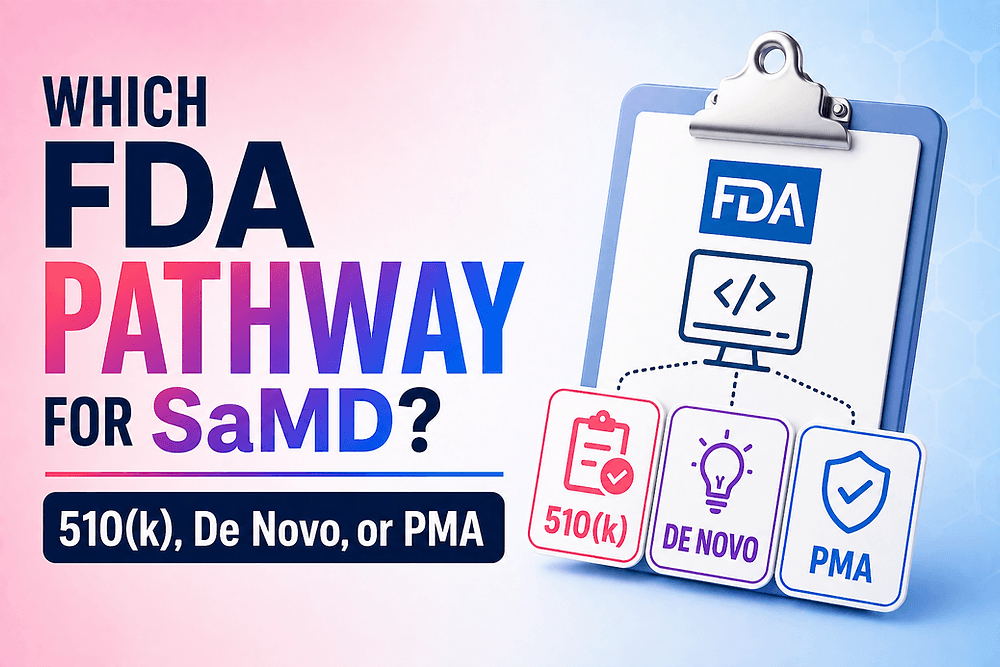
Choosing a SaMD pathway depends on risk, novelty, and predicates. Use 510(k) when a suitable predicate exists for the same intended use and technology (often Class II). Choose De Novo for novel, low–moderate-risk software without a predicate—creating a new classification. Use PMA for Class III/high-risk devices that must demonstrate safety and effectiveness.
Why Choosing the Right SaMD FDA Pathway Matters
If you pick the wrong FDA submission route, the cost isn’t just money—it’s 8–12 months of delay, team fatigue, and missed revenue.
Each pathway:
- Has different timelines
- Requires different supporting evidence
- Triggers different regulatory expectations
So how do you know which one fits your SaMD?
When 510(k) Is the Right Path
510(k) is the most common FDA submission type—and for many SaMDs, it’s exactly what you need.
✅ You qualify if:
- There’s an existing predicate device with the same intended use
- Your software presents moderate risk
- You can demonstrate substantial equivalence
👉 Examples:
- AI for diabetic retinopathy screening (predicate: IDx-DR)
- Cardiac rhythm classifiers
- Decision support software for non-critical conditions
Bonus: many SaMD submitters now use the FDA’s eSTAR template, which can speed up review and improve formatting compliance.
When De Novo Applies Instead
If your software is moderate risk but has a, you’re in De Novo territory.
Key signs you need De Novo:
- You can’t find a similar 510(k) cleared product
- You’re targeting a novel application
- Your risk level is acceptable, but your innovation is first-of-its-kind
👉 Example: IDx-DR — De Novo # DEN180001: autonomous AI software that analyzes retinal fundus images to flag adults with diabetes who have more-than-mild diabetic retinopathy for specialist referral. No predicate existed—De Novo approved.
🧠 Note: Once a De Novo is granted, future similar products can then use it as a predicate
for their own 510(k).
When PMA Is Required
If your software:
- Directly manages or treats a critical condition
- Impacts survival or high-risk therapeutic outcomes
- Or involves life-sustaining decisions without human review
👉 You likely need a Premarket Approval (PMA).
PMA is:
- The most burdensome route
- Requires clinical trials, human factors testing, and robust validation
- Can take 12–24+ months
👉 Example: SecondLook Computer-Aided Detection System — PMA # P010038: image-analysis software that flags suspicious regions on digital mammograms so radiologists can catch potential breast-cancer lesions that might be missed on first read.
The Fastest Path to Market
No more guesswork. Move from research to a defendable FDA strategy, faster. Backed by FDA sources. Teams report 12 hours saved weekly.
FAQs
Q: Can I convert a De Novo into a 510(k)?
Not exactly. But once a De Novo is granted, it becomes a predicate that others can reference in their 510(k) submissions.
Q: What if I upgrade the algorithm after clearance?
You may need a new 510(k) or submit a Predetermined Change Control Plan (PCCP) in advance. FDA wants predictability.
Q: Does EU MDR classification affect my FDA pathway?
Not directly—but if your software is Class IIb or III in Europe, it may signal De Novo or PMA needs in the U.S.