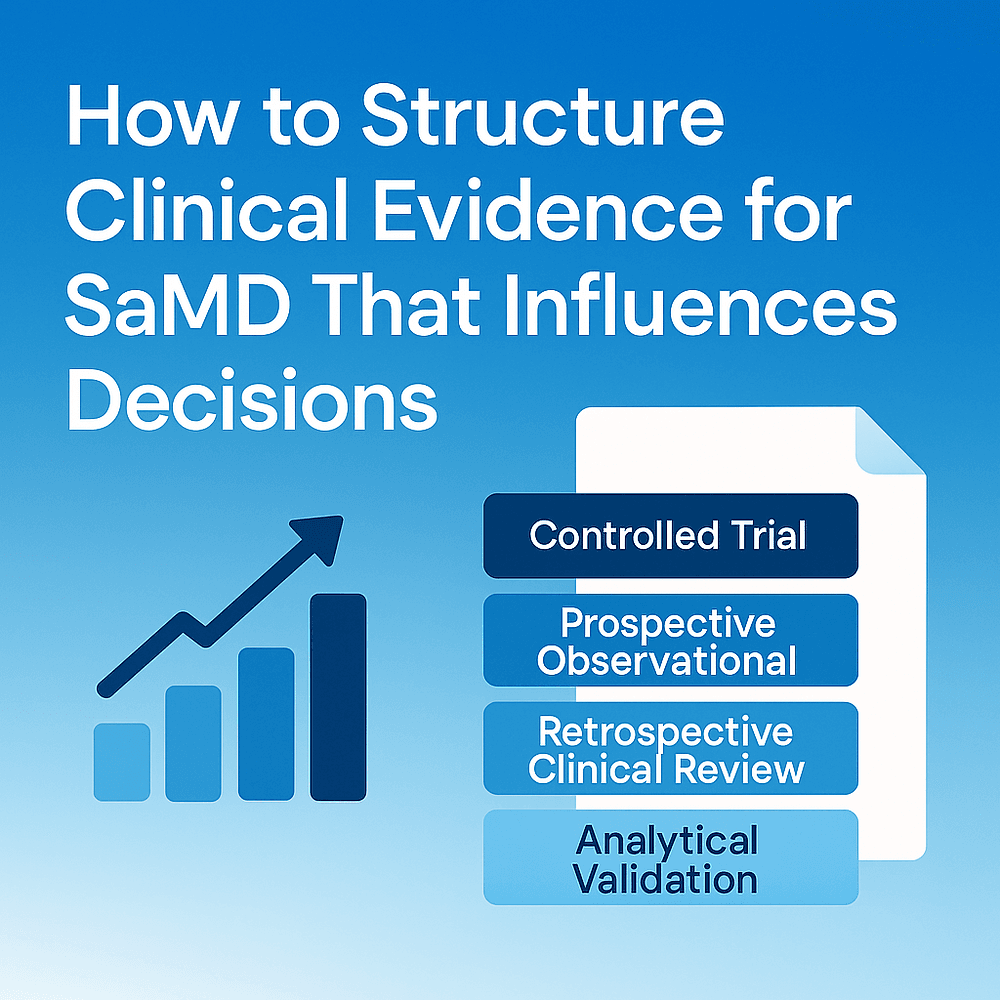
To structure SaMD clinical evidence, build three pillars: valid clinical association (link SaMD output to the condition), analytical validation (technical accuracy/robustness), and clinical validation (benefit/performance in the target population). The rigor scales with your SaMD risk category (significance of information × condition seriousness). Define clear endpoints, populations, and stats up front.
Why Clinical Evidence Matters for SaMD
FDA’s latest guidance signals a shift: for SaMD that influences clinical decisions, real-world performance data is becoming non-negotiable.
- Incomplete or misaligned evidence is the #1 driver of Additional Information (AI) requests.
- The 2025 draft prioritizes fit-for-purpose evidence tied to device function, patient impact, and risk class.
A well-structured clinical evidence plan is your submission's foundation—and credibility booster.
Designing Your Clinical Evidence Plan
Step 1: Define Intended Use and Target Population
- Clearly specify the SaMD’s clinical purpose (e.g., diagnosis, triage, monitoring, prediction).
- Define the clinical setting (e.g., ICU, outpatient, primary care).
- Detail inclusion and exclusion criteria for the intended users and patient population.
- This step ensures the evidence generated is relevant to the real-world use case.
Step 2: Establish Valid Clinical Association
- Demonstrate that the SaMD output is scientifically and clinically associated with the targeted clinical condition or physiological state.
- Use existing literature, clinical guidelines, or generate new evidence if novel.
- This forms the foundation for all further validation steps.
Step 3: Select Study Endpoints and Metrics
- Choose primary endpoints that reflect clinical relevance, such as diagnostic accuracy (sensitivity, specificity), time-to-alert, or prediction performance.
- Include secondary endpoints like impact on provider workflow, usability, or time saved.
- Define measurable, clinically meaningful metrics aligned with intended use.
Step 4: Plan Analytical Validation
- Design tests to verify the SaMD processes input data correctly and produces accurate, reliable, and precise outputs.
- Use bench testing, simulations, or retrospective data.
- Document accuracy metrics, confusion matrices, and error rates.
Step 5: Plan Clinical Validation
- Design studies to demonstrate clinical performance and impact in the target population and setting.
- Possible study designs include retrospective clinical reviews, prospective observational studies, or controlled trials.
- Collect data on clinical outcomes, usability, and safety.
Step 6: Define Statistical Methods and Sample Size
- Calculate sample sizes with adequate statistical power to detect meaningful effects.
- Plan confidence intervals and subgroup analyses (e.g., by age, sex, comorbidities).
- Ensure statistical rigor to support regulatory submissions and clinical claims.
Step 7: Identify Data Sources and Quality Control Measures
- Determine data sources such as electronic health records (EHRs), device logs, clinical registries, or structured case report forms (CRFs).
- Implement SOPs for data extraction, curation, and quality assurance.
- Use validated data collection tools with audit trails to ensure data integrity.
Step 8: Execute Evidence Generation and Documentation
- Conduct analytical and clinical validation activities per plan.
- Analyze data using appropriate statistical methods.
- Document results thoroughly in clinical evaluation reports following regulatory standards.
Step 9: Engage with Regulatory Authorities and Plan Lifecycle Management
- Seek early and ongoing feedback from regulators to ensure alignment.
- Plan for continuous clinical evaluation, including post-market surveillance and real-world data collection.
- Update clinical evidence as the SaMD evolves or new clinical insights emerge.
The Fastest Path to Market
No more guesswork. Move from research to a defendable FDA strategy, faster. Backed by FDA sources. Teams report 12 hours saved weekly.

FAQ
What level of evidence is enough for a 510(k)?
For moderate-risk SaMD (IMDRF Cat II–III), retrospective + prospective observational evidence with analytical validation is typically sufficient.
Do I always need a controlled trial?
No. Controlled trials are ideal for high-risk SaMD (Cat IV) but not always required if strong real-world data exists.
Can real-world evidence replace prospective studies?
Not entirely. Real-world data can supplement but not replace planned studies unless justified via Pre-Sub.