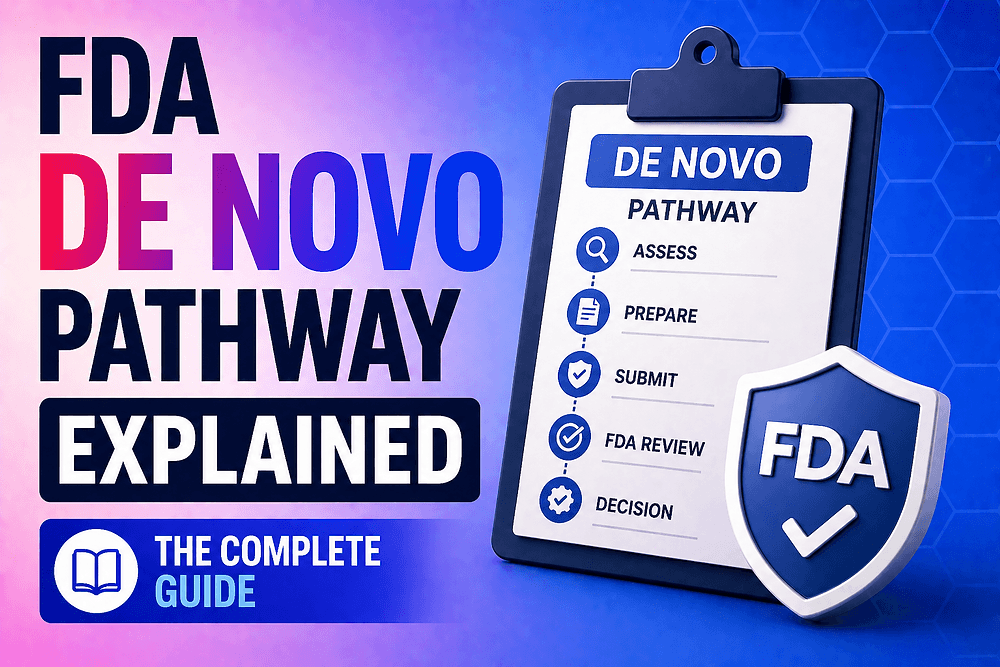
Quick Answer: The De Novo pathway provides marketing authorization for novel, low–to–moderate-risk devices without a predicate, creating a new Class I/II classification with general/special controls (and a product code future 510(k)s can use). It’s authorized by a grant order, not a clearance. eSTAR is required for De Novos starting Oct 1, 2025.
What Exactly Is the De Novo Pathway?
The De Novo pathway addresses a critical gap in medical device regulation. Prior to 1997, novel devices with no predicate were automatically classified as Class III, regardless of their actual risk profile. This created an unnecessarily burdensome regulatory path for innovative but low-risk technologies.
Think of De Novo as the "pioneer pathway."
Your device becomes the first of its kind to receive FDA clearance, establishing a new regulatory category that future similar devices can reference through the 510(k) process.
How De Novo Creates Market Categories
When FDA grants De Novo classification, they:
- Create a new device type with specific regulatory controls
- Assign a unique product code for future reference
- Establish performance standards other manufacturers must meet
- Open the 510(k) pathway for substantially equivalent devices
This means De Novo sponsors essentially create the regulatory roadmap that competitors will follow, providing a significant first-mover advantage.
When Should You Consider De Novo?
Primary Eligibility Criteria
You should strongly consider De Novo if your device meets these conditions:
- No substantially equivalent device is legally marketed
- Similar devices exist but differ significantly in design, technology, or intended use
- You cannot establish substantial equivalence due to fundamental differences
- Device poses minimal patient risk when used as intended
- General controls or general + special controls can ensure safety
- Does not require the extensive clinical data typical of Class III devices
- Represents a new technological approach
- Addresses unmet clinical needs in a unique way
- Cannot be classified under existing device categories
Warning Signs De Novo May Not Be Right
❌ Avoid De Novo if:
- Similar devices already exist on the market (consider 510(k) instead)
- Your device poses high risk to patients (PMA likely required)
- You're trying to avoid 510(k) requirements without justification
- The technology isn't truly novel or innovative
The De Novo Process: Step-by-Step
Phase 1: Pre-Submission Strategy (Recommended)
Timeline: 2-6 months before submission (estimation)
Key Activities:
- Q-Submission meeting with FDA to discuss pathway appropriateness
- Predicate device search to confirm no substantial equivalence exists
- Risk assessment to validate Class I/II classification potential
- Clinical strategy development if studies are needed
Phase 2: Submission Preparation
Key Requirements for De Novo Submission:
Administrative Elements:
- Cover sheet clearly identifying as "De Novo Request"
- Device description including technology and intended use
- Proposed classification (Class I or II) with justification
- User fee payment ($162,235 user fee (2025))
Technical Documentation:
- Safety and effectiveness data demonstrating device performance
- Risk analysis showing controls are sufficient for proposed class
- Labeling and instructions for intended users
- Manufacturing information and quality system compliance
Clinical Evidence (If Required):
- Performance testing data
- Clinical study results (if applicable)
- Literature review supporting safety claims
- Post-market surveillance plan
Phase 3: FDA Review Process
Acceptance Review (15 days): The FDA reviews the De Novo submission for completeness and accepts or rejects it for substantive review within 15 calendar days.
Substantive Review (150 days):
FDA evaluates whether:
- Device truly has no predicate
- Proposed classification is appropriate
- General/special controls provide reasonable assurance of safety and effectiveness
- Documentation supports claims
Potential Outcomes:
- Granted: Device receives Class I or II classification
- Declined: Device has predicate or requires Class III classification
- Additional Information Request: More data needed (stops clock)
De Novo Success Stories and Market Impact
Real-World Examples
Consumer Health Technology:
- Bose Hearing Aid (2018): First FDA-authorized self-fitting, direct-to-consumer air-conduction hearing aid for adults with mild-to-moderate loss.
Clinical Innovation:
- Monarch eTNS System (2019) – External trigeminal-nerve stimulator; first non-drug therapy cleared for pediatric ADHD (ages 7–12).
- Genius™ Digital Diagnostics System with Cervical AI Algorithm (2024) – First AI-assisted digital cytology platform aiding cervical-cancer screening.
- BrainSee™ Prognostic Software (2024) – AI tool predicting progression of mild cognitive impairment toward Alzheimer’s disease.
Market Creation Effect
Half of analyzed De Novo devices served as predicates for products subsequently cleared via the 510(k) pathway, demonstrating how De Novo approval creates entire market categories.
Common De Novo Challenges and Solutions
Challenge 1: Proving "No Predicate" Status
The Problem: FDA may identify predicate devices you overlooked
Solution: Conduct comprehensive predicate searches and document why similar devices aren't substantially equivalent
Challenge 2: Clinical Evidence Requirements
The Problem: One-fifth of De Novo devices weren't evaluated in pivotal studies, and one-third failed to meet primary effectiveness endpoints
Solution: Develop robust clinical strategy early, consider alternative study designs
Challenge 3: Timeline Uncertainties
The Problem: FDA review times vary, with final decisions potentially taking 250 days from initial submission
Solution: Build buffer time into product launch planning, maintain proactive FDA communication
Challenge 4: High Upfront Costs
The Problem: $162,235 user fee (2025) plus development costs
Solution: Ensure strong business case before proceeding, consider pathway comparison analysis
De Novo vs. Alternative Pathways: Decision Framework
Use This Decision Tree:
- Yes → Consider 510(k) pathway
- No → Continue to step 2
- Yes → De Novo likely appropriate
- No → PMA pathway required
- Yes → Strong De Novo candidate
- No → May require Class III classification
- Yes → Proceed with De Novo strategy
- No → Consider partnerships or alternative timing
More info on 510(K) vs DeNovo vs PMA here.
Best Practices for De Novo Success
- Start Early with FDA Engagement Schedule Q-Sub meetings 6-12 months before intended submission to align on expectations and requirements.
Start Early with FDA Engagement
- Build Robust Clinical Evidence Even if not required, strong clinical data significantly improves approval chances and market acceptance.
Build Robust Clinical Evidence
- Develop Comprehensive Risk Management Demonstrate how proposed controls adequately address all identified risks without requiring Class III oversight.
Develop Comprehensive Risk Management
- Plan for Post-Market Requirements Prepare surveillance systems and be ready for potential post-market study requirements.
Plan for Post-Market Requirements
- Consider Competitive Landscape Analyze how De Novo approval will impact your market position and competitor responses.
Consider Competitive Landscape
Looking Ahead: De Novo Trends and Changes
Current Market Dynamics
Through March 2025, the FDA granted three De Novo classifications (vs at least five in Q1 2024), a difference that likely reflects submission timing rather than a formal shift in FDA policy.
Emerging Technologies Using De Novo
- AI/ML diagnostic tools for medical imaging
- Digital therapeutics for mental health and chronic disease management
- Wearable medical devices for continuous monitoring
- Novel surgical robotics for minimally invasive procedures
Regulatory Evolution
FDA continues refining the De Novo process, with recent guidance emphasizing:
- Clearer predicate device analysis requirements
- Enhanced clinical evidence expectations
- Streamlined submission formatting through eSTAR
Key Takeaways
The De Novo pathway represents a critical opportunity for medical device companies developing truly innovative technologies. While the process requires significant investment and carries inherent risks, successful De Novo approval can establish market leadership and create substantial competitive advantages.
Remember these essential points:
- De Novo is for novel devices without predicates, not difficult 510(k) cases
- Early FDA engagement significantly improves success rates
- Clinical evidence requirements are becoming more stringent
- Approval creates new market categories for future competition
- Timeline and cost planning should include potential delays and additional requests
The Fastest Path to Market
Frequently Asked Questions
Q: How long does the De Novo process typically take?
A: FDA's goal is 150 days for review, but companies should expect 250 days when including potential holds for additional information requests.
Q: Can I submit directly to De Novo, or do I need to fail a 510(k) first?
A: Since 2021, FDA allows "direct to De Novo" submissions, eliminating the need to receive a "not substantially equivalent" decision first.
Q: What happens if my De Novo is declined?
A: You may need to pursue PMA approval for Class III classification or demonstrate substantial equivalence to an existing predicate through 510(k).
Q: Can software qualify for De Novo classification?
A: Yes, Software as a Medical Device (SaMD) frequently uses the De Novo pathway, especially for novel AI/ML applications without existing predicates.
Q: How does De Novo approval affect my intellectual property strategy?
A: De Novo approval can create competitive advantages but may also facilitate follow-on innovation by establishing new regulatory categories.