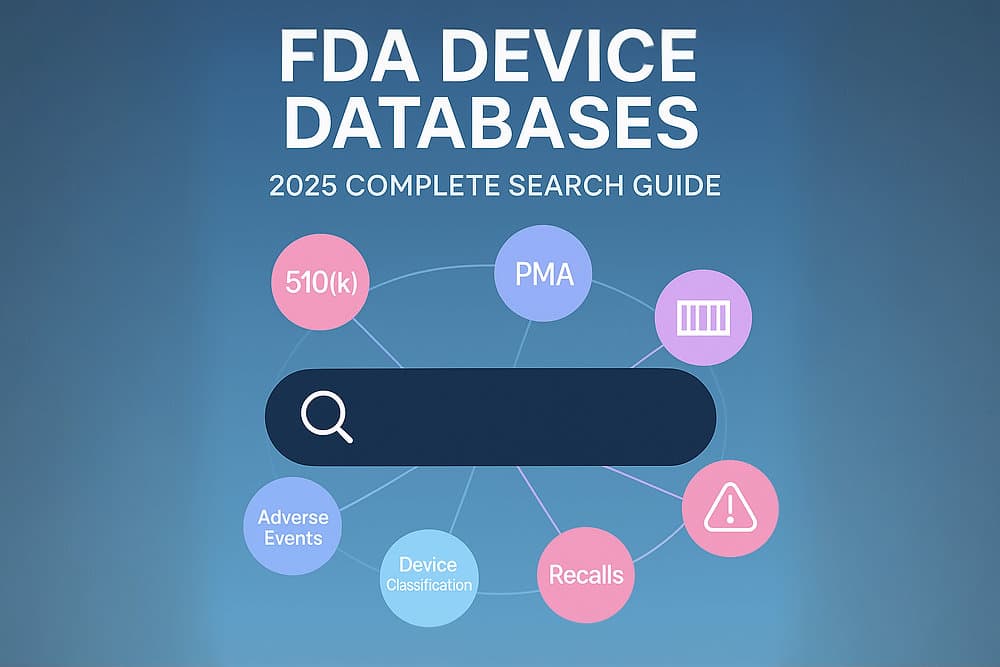
FDA maintains 15+ medical device databases containing approval data, adverse events, manufacturer information, and regulatory guidance. The most critical are the 510(k) database for predicate devices, PMA database for Class III research, Product Classification for device codes, and MAUDE for safety intelligence. Smart companies use these databases for competitive intelligence, faster regulatory submissions, and market analysis.
Most regulatory professionals waste hours manually searching FDA databases when strategic approaches could deliver better competitive intelligence in minutes. This comprehensive guide shows you exactly how to extract maximum value from each database to accelerate your regulatory strategy and gain competitive advantages.
Why FDA Databases Are Strategic Weapons
FDA databases aren't just regulatory archives—they're treasure troves of competitive intelligence, predicate data, and submission benchmarks that can help you streamline premarket submissions and understand market dynamics.
Strategic Value:
- Predicate Device Intelligence - Find substantially equivalent devices for 510(k) submissions
- Competitive Analysis - Track competitor approvals, claims, and safety issues
- Market Timing - Identify approval patterns and regulatory trends
- Risk Assessment - Understand adverse events and recall patterns
- Regulatory Strategy - Learn from successful submission approaches
The Problem: FDA search engines don't allow specific search queries, hampering accessibility. Most companies waste hours manually searching when strategic approaches could deliver better results in minutes.
💡 The faster way to leverage FDA databases
Instead of manually searching across 15+ FDA databases, Complizen connects them for you - instantly mapping product codes, predicates, recalls, and recognized standards.
It’s how modern regulatory teams turn hours of research into actionable strategy in minutes.
Pre-Market Intelligence Databases
510(k) Pre-Market Notification Database
Purpose: Find predicate devices for substantial equivalence claims
What's Inside:
- All released 510(k) submissions since 1976
- Device names, product codes, summaries, and decisions
- Predicate device chains and substantial equivalence arguments
- Approval timelines and FDA review patterns
Strategic Search Techniques:
- Search tip: Use partial codes (e.g., "MR" for cardiovascular) to broaden results
- Cross-reference with Product Classification database for complete code lists
- Example: Search "glucose monitor" before "continuous glucose monitor"
- Include synonyms and technical variations
- Recent approvals (last 2 years) show current FDA expectations
- Historical data reveals regulatory evolution and precedent
Competitive Intelligence Applications:
- Track Competitor Activity: Set up regular searches for competitor company names
- Identify Market Gaps: Find product codes with few recent approvals
- Benchmark Claims: Compare your intended claims with successful submissions
- Timing Analysis: Understand seasonal approval patterns and FDA review times
Access: FDA 510(k) Database
PMA Pre-Market Approval Database
Purpose: Research Class III device approvals and high-risk regulatory pathways
What's Inside:
- All PMA approvals and supplements since 1976
- Clinical trial requirements and study designs
- Post-approval study commitments
- Approval conditions and labeling restrictions
Key Search Strategies:
- Search tip: Use broad anatomical terms (e.g., "cardiac," "orthopedic")
- Review approval letters for clinical trial design insights
- Identify companies with multiple PMA approvals in your space
- Study their clinical development approaches and timelines
Clinical Intelligence Extraction:
- Study Design Precedents: Understand FDA expectations for clinical trials
- Endpoint Selection: See what primary endpoints FDA accepted
- Patient Population: Learn about inclusion/exclusion criteria
- Post-Market Commitments: Understand ongoing study requirements
Access: FDA PMA Database
Product Classification Database
Purpose: Understand device classifications, product codes, and regulatory pathways
What's Inside:
- All medical devices with 3-letter product codes
- Risk classifications (Class I, II, III)
- Regulatory controls and special controls
- FDA review organizations
Essential Search Methods:
- Search multiple device name variations
- Review "device class" and "regulation number"
- Understand "classification product code" implications
- Review all devices within your product code
- Identify classification precedents for similar technologies
- Understand regulatory controls and requirements
Strategic Classification Intelligence:
- Pathway Planning: Determine if 510(k), PMA, or De Novo applies
- Competitive Landscape: See all devices in your category
- Regulatory Requirements: Understand special controls and standards
- Innovation Opportunities: Identify product codes with few devices
Access: Product Classification Database
De Novo Classification Database
Purpose: Research novel device pathways and emerging technologies
What's Inside:
- All De Novo classification orders since 2012
- Risk-based special controls for novel devices
- Predicate-creating approvals for new device categories
- Innovation pathway precedents
Advanced Search Techniques:
- Search broad technology terms (e.g., "artificial intelligence," "wireless")
- Review special controls established for novel technologies
- Study rationale for Class II classification decisions
- Learn about risk mitigation strategies that satisfied FDA
Innovation Intelligence:
- Technology Trends: Identify emerging device categories
- Special Controls: Understand requirements for novel technologies
- Market Entry: Find successful precedents for breakthrough innovations
- Predicate Creation: Become the predicate for future devices
Access: De Novo Database
Devices@FDA Quick Search
Purpose: Combined search across 510(k) and PMA databases
What's Inside:
- Simplified interface for basic searches
- Device name and approval date filtering
- Quick competitor analysis capabilities
Best Use Cases:
- Initial Market Scans: Quick overview of approval landscape
- Competitor Monitoring: Regular checks on competitor activity
- Broad Technology Searches: When you need general market intelligence
Limitations: Less detailed search options than individual databases
Access: Devices@FDA
Post-Market Intelligence Databases
MAUDE - Medical Device Reports
Purpose: Track adverse events, safety issues, and device performance
What's Inside:
- Mandatory reports from manufacturers, importers, and device user facilities
- Voluntary reports from healthcare professionals and patients
- Death, injury, and malfunction reports
- Trending safety signals and emerging issues
Critical Search Strategies:
- Set up regular searches to track safety trends
- Compare adverse event rates between competitors
- Identify common failure modes and design issues
- Search "death," "injury," or "malfunction" for severity analysis
- Track recurring problems across multiple manufacturers
- Identify user error patterns and training opportunities
- Risk Benchmarking: Compare your safety profile to competitors
- Design Insights: Learn from others' device failures
- Regulatory Risks: Identify devices under FDA scrutiny
- Market Opportunities: Find underperforming competitors
Red Flags to Watch:
- Multiple reports of same failure mode
- Increasing report frequency over time
- Reports mentioning "recall" or "FDA investigation"
- Class I recall recommendations in reports
Access: MAUDE Database
Medical Device Recalls Database
Purpose: Monitor recall activity and root cause analysis
What's Inside:
- All medical device recalls since November 2002
- Recall classifications (Class I, II, III)
- Root cause analysis and corrective actions
- Manufacturer recall strategies and effectiveness
Strategic Recall Intelligence:
- Identify common recall reasons in your device category
- Understand typical corrective actions and timelines
- Benchmark recall response strategies
- Software issues, manufacturing defects, labeling problems
- Use insights for risk management and design controls
- Prevent similar issues in your own devices
Access: Medical Device Recalls
Registration & Listing Database
Purpose: Research manufacturer information and market presence
What's Inside:
- All establishments manufacturing medical devices
- Device listings in commercial distribution
- Manufacturer locations and capabilities
- Annual registration updates
Competitive Intelligence Applications:
- Supply Chain Analysis: Identify contract manufacturers
- Market Mapping: Understand geographic distribution of manufacturers
- Partnership Opportunities: Find potential manufacturing partners
- Competitive Monitoring: Track new market entrants
Access: Registration & Listing Database
AccessGUDID - Unique Device Identification
Purpose: Device identification and supply chain intelligence
What's Inside:
- Unique Device Identifiers (UDI) for all medical devices
- Device specifications and identifiers
- Manufacturing and distribution information
- Global Medical Device Nomenclature (GMDN) data
Strategic UDI Intelligence:
- Product Differentiation: Understand detailed device specifications
- Supply Chain Mapping: Track device distribution patterns
- Competitive Analysis: Compare technical specifications
- Market Segmentation: Identify device variants and configurations
Access: AccessGUDID
Total Product Lifecycle (TPLC) Database
Purpose: Comprehensive device lifecycle view from pre-market to post-market
What's Inside:
- Combined pre-market and post-market data
- PMA and 510(k) approvals linked to adverse events and recalls
- Full device lifecycle intelligence in one interface
- Product line reports and trending analysis
Advanced Lifecycle Intelligence:
- Holistic Risk Assessment: Connect approval data with safety performance
- Long-term Performance: Track device performance over time
- Competitive Benchmarking: Complete competitor lifecycle analysis
- Investment Decisions: Understand full commercial success factors
Access: TPLC Database
522 Post-Market Surveillance Studies
Purpose: Track mandatory post-market study requirements
What's Inside:
- Studies required under Section 522 of FD&C Act
- Study protocols and progress reports
- Manufacturer compliance with study commitments
- Real-world evidence generation requirements
Post-Market Intelligence:
- Regulatory Expectations: Understand FDA's post-market evidence requirements
- Competitive Burden: Assess ongoing study commitments for competitors
- Evidence Strategy: Learn from successful post-market study designs
Access: 522 Post-Market Studies
Reference & Compliance Databases
CFR Title 21- Federal Regulations
Purpose: Searchable access to medical device regulations
What's Inside:
- Complete Code of Federal Regulations for medical devices
- Part 820 (Quality System Regulation)
- Part 801 (Labeling requirements)
- Part 814 (PMA regulations)
Regulatory Intelligence:
- Compliance Requirements: Understand specific regulatory obligations
- Historical Changes: Track regulatory evolution over time
- Interpretation Guidance: Find official regulatory language
Access: eCFR Title 21
FDA Guidance Documents Database
Purpose: FDA's interpretation of regulations and policies
What's Inside:
- Current guidance documents across all medical device topics
- Draft and final guidance with implementation timelines
- Withdrawn guidance and historical policy evolution
- Search by product, topic, or FDA organization
Strategic Guidance Intelligence:
- Regulatory Interpretation: Understand FDA's current thinking
- Submission Strategy: Learn best practices from official guidance
- Emerging Policies: Track draft guidance for future requirements
- Historical Context: Understand policy evolution and precedent
Access: FDA Guidance Documents
FDA Recognized Consensus Standards
Purpose: Voluntary standards accepted by FDA for device approval
What's Inside:
- FDA-recognized voluntary consensus standards
- Standards organizations and development bodies
- Search by standard number, product code, or keyword
- Declaration of conformity acceptance criteria
Standards Intelligence:
- Submission Shortcuts: Use recognized standards to streamline approvals
- Competitive Standards: See which standards competitors reference
- Emerging Requirements: Track newly recognized standards
- International Harmonization: Understand global standards acceptance
Access: Recognized Consensus Standards
International Regulatory Databases
While FDA databases provide comprehensive US market intelligence, global medical device companies need broader regulatory visibility.
European Union - EUDAMED
Purpose: EU Medical Device Regulation (MDR) compliance and market intelligence
What's Inside:
- CE-marked device registrations
- Authorized representative information
- Clinical investigation data
- Post-market surveillance reports
Key Differences from FDA:
- Focuses on conformity assessment rather than pre-market approval
- Includes notified body certificates and decisions
- Post-market clinical follow-up (PMCF) data
- Unique Device Identification (UDI) database integration
Strategic Value: Essential for EU market entry and global competitive intelligence
Access: EUDAMED Portal
Health Canada Medical Device License Database
Purpose: Canadian market approval and device intelligence
What's Inside:
- Medical Device Licenses (MDL) for Class II-IV devices
- Device identification and specifications
- License holder information and conditions
- Regulatory pathway and classification decisions
Intelligence Applications:
- North American Strategy - Compare US 510(k) vs Canadian MDL approaches
- Competitive Timing - Track competitor market entry sequences
- Regulatory Precedent - Understand Canadian-specific requirements
Access: Health Canada Medical Device License Database
TGA Australian Database
Purpose: Therapeutic goods administration device registrations
What's Inside:
- Australian Register of Therapeutic Goods (ARTG)
- Device classifications and regulatory pathways
- Sponsor information and conditions
- Conformity assessment procedures
Strategic Applications: Pacific market intelligence and regulatory harmonization insights
Global Harmonization Considerations
Regulatory Intelligence Strategy:
- Use FDA databases for detailed technical and safety intelligence
- Leverage international databases for global market timing and competitive positioning
- Cross-reference approval sequences to understand multinational regulatory strategies
- Monitor international adverse event patterns for comprehensive risk assessment
Market Entry Sequencing: Many companies use FDA approval as global regulatory precedent, making US database intelligence valuable for worldwide strategy planning.
Advanced Search Strategies
Power User Techniques
Boolean Search Logic:
- Use AND, OR, NOT operators for precise results
- Combine multiple search fields for targeted intelligence
- Use quotation marks for exact phrase matching
Date Range Optimization:
- Recent Activity: Last 12 months for current market intelligence
- Historical Trends: 3-5 year ranges for market evolution analysis
- Regulatory Shifts: Compare pre/post guidance or regulation changes
Cross-Database Validation:
- Start with Product Classification for device codes
- Use 510(k) database for predicate research
- Validate with MAUDE for safety intelligence
- Confirm with TPLC for complete lifecycle view
Competitive Intelligence Workflows
New Competitor Analysis:
- Search Registration & Listing for company information
- Review 510(k)/PMA databases for approved devices
- Check MAUDE for safety performance
- Analyze TPLC for complete competitive profile
Market Entry Research:
- Product Classification for regulatory pathway
- 510(k)/PMA/De Novo for precedent analysis
- Standards database for compliance requirements
- Guidance documents for submission strategy
Ongoing Market Monitoring:
- Set up regular searches for competitor activity
- Monitor adverse event trends in your product category
- Track new guidance and standards affecting your market
- Analyze approval patterns and timing trends
Common Mistakes to Avoid
Search Strategy Errors
- Mistake: Using only exact device names
- Solution: Start broad, then narrow with product codes and synonyms
- Mistake: Ignoring date ranges
- Solution: Recent data shows current FDA expectations; historical data provides precedent
- Mistake: Single database searches
- Solution: Cross-reference multiple databases for complete intelligence
Data Interpretation Pitfalls
- Mistake: Assuming all 510(k) predicates are valid
- Solution: Verify predicate device is still legally marketed and appropriate
- Mistake: Over-interpreting MAUDE data
- Solution: Consider reporting bias and denominator issues
- Mistake: Ignoring recall patterns
- Solution: Use recall intelligence for risk management and design improvements
Competitive Intelligence Missteps
- Mistake: Focusing only on direct competitors
- Solution: Monitor adjacent technologies and emerging players
- Mistake: Ignoring post-market performance
- Solution: Connect approval data with real-world safety performance
Next Steps: Turning Database Intelligence into Strategy
FDA databases provide the raw intelligence needed for smarter regulatory decisions, but the real value comes from systematic analysis and strategic application.
Immediate Actions:
- Audit Your Current Approach - How are you currently using these databases?
- Set Up Monitoring Systems - Create regular search schedules for competitive intelligence
- Train Your Team - Ensure regulatory and business development teams know these advanced techniques
- Integrate with Strategy - Connect database insights to regulatory pathway planning and competitive positioning
Advanced Applications:
- Predicate Strategy Optimization - Find the strongest predicate chains for your 510(k)
- Clinical Development Planning - Use PMA precedents to design efficient clinical trials
- Risk Management - Leverage MAUDE intelligence for proactive safety planning
- Market Timing - Understand FDA review patterns for optimal submission timing
FDA databases transform from overwhelming bureaucratic tools into strategic weapons when you know how to extract the right intelligence. Master these search techniques, and you'll make faster regulatory decisions, avoid costly mistakes, and gain significant competitive advantages.
Ready to dive deeper into regulatory strategy? Explore our guides on 510(k) predicate selection, PMA clinical development, and regulatory pathway optimization to turn database intelligence into approval success.
The Fastest Path to Market
Frequently Asked Questions
How often are FDA databases updated?
Most FDA databases update daily or weekly. The 510(k) and PMA databases typically update within 24-48 hours of FDA decisions. MAUDE updates continuously as reports are submitted. Registration & Listing updates weekly, usually every Monday.
Can I set up automated alerts for FDA database changes?
Yes, several databases offer RSS feeds and email alerts. The 510(k) database allows email notifications for specific product codes. MAUDE offers RSS feeds for adverse event monitoring. For comprehensive automated monitoring across all databases, specialized platforms like Complizen provide unified alerting systems.
Are FDA database searches free?
All FDA database searches are completely free. These are public databases funded by taxpayers. However, accessing and analyzing data efficiently often requires significant time investment or specialized tools for systematic competitive intelligence.
How far back do FDA databases go?
Most databases contain decades of historical data. The 510(k) database includes submissions since 1976. PMA data goes back to 1976. MAUDE contains reports since 1991, with more detailed data from 2000 forward. Device recalls are available from November 2002 onward.
Can I download bulk data from FDA databases?
Yes, most databases offer bulk download options. AccessGUDID provides complete database downloads. The 510(k) and PMA databases allow filtered exports. However, bulk data often requires technical processing to extract actionable intelligence.
What's the difference between searching individual databases vs. combined platforms?
Individual FDA databases offer detailed search options but require manual correlation across multiple sources. Combined platforms like Devices@FDA provide convenient searching but limited functionality. Comprehensive platforms unify all databases with advanced analytics and cross-referencing capabilities.
How do I know if my predicate device search is complete?
Effective predicate searches require multiple validation steps: Search by device name AND product code, verify the predicate is still legally marketed, check for recalls or safety issues in MAUDE, and confirm substantial equivalence arguments in the 510(k) summary.
Are international regulatory databases as comprehensive as FDA databases?
No, most international databases are less detailed than FDA databases. EUDAMED focuses on registration rather than detailed technical submissions. Health Canada's database provides basic device information but limited competitive intelligence. FDA databases remain the gold standard for regulatory intelligence depth.