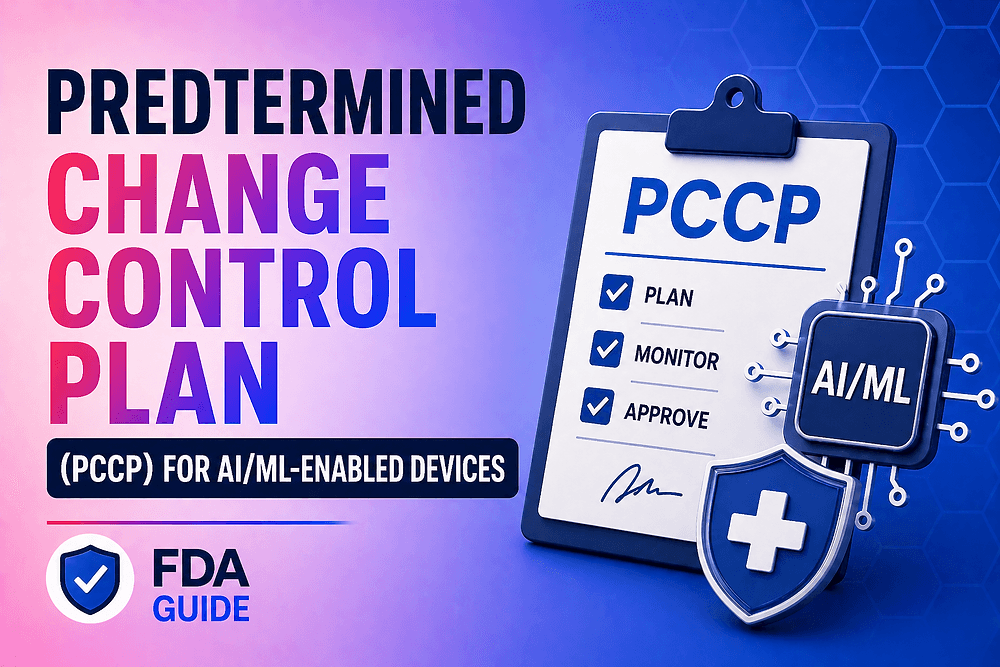
A Predetermined Change Control Plan (PCCP) is FDA documentation that lets you pre-define specific AI/ML software changes—and the methods to develop, validate, implement, and monitor them—so those updates can be made without a new marketing submission, when executed exactly as an authorized PCCP. PCCPs include three components: Description of Modifications, Modification Protocol, and Impact Assessment. Available for 510(k), De Novo, and PMA pathways for AI-enabled device software functions.
This guide covers the final December 2024 FDA guidance requirements, implementation strategies, and practical examples for successful PCCP development.
What Is a Predetermined Change Control Plan (PCCP)?
A Predetermined Change Control Plan is a regulatory framework that allows manufacturers to implement pre-approved modifications to AI-enabled medical devices without submitting supplemental marketing applications for each change. This approach addresses the iterative nature of AI/ML development while maintaining safety and effectiveness standards.
Why PCCPs Are Essential for AI Medical Devices
Traditional Change Control Limitations: Conventional medical device change control requires new submissions (Special 510(k), PMA supplement) for significant software modifications. For AI devices that continuously learn and improve, this creates regulatory bottlenecks that can delay critical updates.
PCCP Strategic Advantages:
- Continuous Innovation: Implement AI improvements without regulatory delays
- Cost Reduction: Eliminate expensive supplemental submission cycles
- Competitive Edge: Deploy algorithmic enhancements faster than competitors
- Patient Benefit: Accelerate delivery of improved diagnostic accuracy and treatment outcomes
FDA Regulatory Authority
The FDA's PCCP authority stems from the Food and Drug Omnibus Reform Act (FDORA) of 2022, which added section 515C to the Federal Food, Drug, and Cosmetic Act. This provides express statutory authority for FDA to authorize predetermined change control plans as part of initial marketing submissions.
AI-DSF Definition and Scope
Updated FDA Terminology (2025)
The final FDA guidance transitioned from "Machine Learning-Enabled Device Software Functions (ML-DSF)" to "Artificial Intelligence-Enabled Device Software Functions (AI-DSF)" to reflect broader AI application scope.
FDA AI Definition: "A machine-based system that can, for a given set of human-defined objectives, make predictions, recommendations, or decisions influencing real or virtual environments."
AI-DSF Definition: "A device software function that implements an AI model" and includes various AI techniques beyond just machine learning algorithms.
PCCP Applicability
Devices Eligible for PCCP:
- AI-enabled medical devices across all risk classifications
- Device-led combination products with AI-DSF components
- Software as Medical Device (SaMD) with AI functionality
- Traditional medical devices with embedded AI algorithms
Regulatory Pathways:
- 510(k) Premarket Notification: Most common pathway for AI device modifications
- De Novo Classification Request: Novel AI devices establishing new device classifications
- PMA Applications: High-risk AI devices requiring comprehensive safety and effectiveness data
Exclusions:
- Minor software maintenance that doesn't affect safety or effectiveness (covered under Quality System Regulation)
- Changes to drug or biologic components of combination products
- Modifications outside the original device intended use without specific justification
Three Essential PCCP Components
Component 1: Description of Modifications
This section specifies exactly what changes will occur to the AI-DSF and their expected impact on device performance.
Required Elements:
Specific Modification Types:
- Algorithm parameter adjustments and threshold modifications
- Training data updates and model retraining procedures
- Performance metric improvements (sensitivity, specificity, accuracy)
- User interface enhancements that affect AI functionality
- Integration updates for interoperable system compatibility
Device Characteristic Changes:
- Quantified performance improvements with statistical bounds
- Changes to device outputs, alerts, or recommendations
- Modifications to data input requirements or processing methods
- Updates to risk mitigation measures or safety controls
Implementation Approach:
- Automatic updates through software deployment systems
- Manual updates requiring healthcare provider intervention
- Hybrid approaches with user confirmation requirements
- Rollback procedures for unsuccessful modifications
Example Description: "The AI-DSF will implement algorithm parameter adjustments to improve diagnostic accuracy for detecting diabetic retinopathy in retinal images. Modifications include sensitivity threshold adjustments (±5%), specificity optimization (target >95%), and integration of additional training data representing diverse patient populations. Updates will be deployed automatically with healthcare provider notification and 30-day performance monitoring period."
Component 2: Modification Protocol
This section details the systematic approach for developing, validating, and implementing the planned modifications.
Development Methodology:
Data Management Procedures:
- Training data collection and validation protocols
- Data quality assessment and bias evaluation methods
- Dataset versioning and change documentation procedures
- Performance monitoring data collection and analysis plans
Validation and Testing Requirements:
- Pre-deployment testing protocols with acceptance criteria
- Clinical validation methods for performance verification
- Real-world performance monitoring and assessment procedures
- Failure detection and response mechanisms
Implementation Controls:
- Change authorization and approval workflows
- Deployment scheduling and rollout procedures
- User notification and training requirements
- Documentation and audit trail maintenance
Quality Assurance Integration:
- Integration with existing Quality Management System (QMS)
- Design control procedures for modification management
- Risk management updates and assessment protocols
- Corrective and Preventive Action (CAPA) procedures for modification failures
Example Protocol: "Algorithm modifications will be validated using a holdout test dataset of 10,000 retinal images with confirmed diagnoses. Performance criteria require sensitivity ≥90% and specificity ≥95% with 95% confidence intervals. Successful validation triggers automated deployment with real-time performance monitoring for 30 days. Any performance degradation >5% triggers automatic rollback to previous algorithm version."
Component 3: Impact Assessment
This section evaluates the potential effects of planned modifications on device safety, effectiveness, and benefit-risk profile.
Safety Impact Analysis:
Patient Safety Considerations:
- Potential for false positive/negative results and clinical consequences
- Changes to diagnostic accuracy and treatment decision impact
- Risk mitigation measures for modification failures
- User training requirements for modified device functionality
Clinical Effectiveness Assessment:
- Expected improvements to patient outcomes and diagnostic accuracy
- Quantified performance metrics with statistical confidence intervals
- Clinical workflow integration and healthcare provider impact
- Long-term monitoring and assessment procedures
Risk-Benefit Analysis:
- Detailed risk assessment using ISO 14971 methodology
- Benefit quantification with clinical outcome improvements
- Risk mitigation strategies and control measures
- Post-market surveillance and monitoring plans
Stakeholder Impact:
- Healthcare provider training and workflow modification requirements
- Patient communication about device updates and performance changes
- Integration impact on healthcare IT systems and interoperability
- Regulatory reporting and notification procedures
Example Assessment: "Algorithm improvements are expected to reduce false negative rates by 15%, potentially preventing 150 missed diagnoses per 10,000 screenings. Clinical benefits include earlier diabetic retinopathy detection and treatment initiation. Risks include temporary performance variation during algorithm transition, mitigated by 30-day parallel monitoring and immediate rollback capability. Healthcare providers will receive automated performance reports and modification notifications."
PCCP Development Strategy
Pre-Development Planning
Device Classification Analysis: Determine appropriate regulatory pathway based on device risk classification and AI-DSF complexity. Higher-risk devices require more comprehensive PCCP documentation and validation protocols.
Intended Use Boundary Definition: Clearly establish the scope of modifications that remain within original device intended use. Any changes that might affect indications for use require careful justification and additional regulatory consideration.
Stakeholder Engagement:
- FDA Pre-Submission Meetings: Discuss PCCP strategy and obtain agency feedback
- Clinical Partners: Validate modification protocols with end-users
- IT Integration Teams: Ensure compatibility with healthcare system requirements
Technical Implementation
AI Model Architecture Considerations:
- Modular design enabling component-level modifications
- Version control systems for algorithm and training data management
- Performance monitoring integration and automated testing capabilities
- Rollback mechanisms for unsuccessful modifications
Data Infrastructure Requirements:
- Secure data collection and storage systems for ongoing training
- Performance monitoring and analytics platforms
- Real-world evidence collection and analysis capabilities
- Integration with existing healthcare IT systems
Quality System Integration:
- Design control procedures for PCCP-covered modifications
- Risk management file updates and maintenance procedures
- Document control and change management protocols
- Training and competency management for development teams
Regulatory Submission Preparation
Documentation Organization: Structure PCCP documentation as standalone section within marketing submission, clearly cross-referenced with device description, risk analysis, and clinical evaluation sections.
Evidence Package Development:
- Historical performance data demonstrating algorithm reliability
- Validation study results supporting modification protocols
- Risk analysis documentation with mitigation strategies
- Clinical evidence supporting expected performance improvements
FDA Interaction Strategy:
- Schedule Q-Submission meetings to validate PCCP approach
- Prepare responses to anticipated FDA questions about modification scope
- Develop communication plan for post-market performance reporting
- Establish ongoing dialogue channels for PCCP implementation updates
Common PCCP Mistakes and How to Avoid Them
Scope and Boundary Errors
Mistake: Overly broad modification descriptions that exceed intended use boundaries
Impact: FDA rejection or requests for additional clinical data
Solution: Clearly define specific, bounded modifications with quantified performance parameters
Mistake: Insufficient justification for modifications that approach indications for use changes
Impact: Regulatory delays and additional submission requirements
Solution: Provide comprehensive rationale with clinical evidence supporting safety within current intended use
Technical Implementation Failures
Mistake: Inadequate validation protocols that don't demonstrate modification effectiveness
Impact: FDA questions about modification safety and effectiveness assurance
Solution: Develop rigorous testing protocols with statistical validation and acceptance criteria
Mistake: Missing rollback procedures for unsuccessful modifications
Impact: Patient safety concerns and regulatory compliance issues
Solution: Implement automated rollback systems with performance monitoring triggers
Documentation and Process Errors
Mistake: Inconsistency between PCCP components and other submission sections
Impact: FDA confusion and additional information requests
Solution: Ensure alignment between PCCP, device description, risk analysis, and clinical evaluation
Mistake: Insufficient integration with Quality Management System procedures
Impact: Post-market compliance challenges and audit findings
Solution: Integrate PCCP procedures with existing QMS design controls and change management
Strategic Implementation by Regulatory Pathway
510(k) Submission Strategy
Substantial Equivalence Considerations:
- Demonstrate that PCCP modifications maintain substantial equivalence to predicate device
- Reference predicate device performance characteristics in modification boundaries
- Address any performance improvements that might affect equivalence determination
Predicate Device Analysis:
- Identify predicate devices with similar AI functionality and modification approaches
- Compare PCCP scope with predicate device capabilities and performance
- Document how modifications maintain or improve upon predicate device performance
Documentation Focus:
- Emphasize modification protocol validation and testing procedures
- Demonstrate robust performance monitoring and quality controls
- Reference FDA consensus standards for AI device development where applicable
De Novo RequestIntegration
Special Controls Development:
- Incorporate PCCP requirements into proposed special controls framework
- Demonstrate how modification protocols support novel device classification
- Establish precedent for future 510(k) submissions referencing PCCP approach
Risk-Benefit Framework:
- Comprehensive risk analysis addressing novel AI device functionality
- Benefit quantification with clinical evidence supporting PCCP approach
- Post-market study commitments for long-term modification effectiveness assessment
Innovation Pathway Benefits:
- Position PCCP as enabling technology for continuous AI device improvement
- Demonstrate regulatory pathway efficiency for AI device modifications
- Establish framework for similar devices in device classification
PMA Application Enhancement
Clinical Evidence Integration:
- Incorporate PCCP validation data into comprehensive clinical evaluation
- Design clinical studies to support modification protocol validation
- Include post-market study protocols for ongoing PCCP effectiveness assessment
Manufacturing and Quality:
- Demonstrate PCCP integration with manufacturing quality systems
- Address scale-up considerations for modification deployment procedures
- Include post-market surveillance protocols specific to PCCP modifications
Post-Market Commitments:
- Establish ongoing performance monitoring and reporting requirements
- Commit to regular PCCP effectiveness assessment and FDA communication
- Include modification failure analysis and corrective action protocols
Post-Market Implementation
Performance Monitoring Requirements
Real-World Evidence Collection:
- Continuous performance monitoring with statistical process control
- Real-world effectiveness assessment compared to pre-market validation
- Adverse event monitoring specific to AI-DSF modifications
- User feedback collection and analysis procedures
Reporting and Communication:
- Regular performance reports to FDA with modification effectiveness data
- Healthcare provider communication about device updates and performance changes
- Patient notification procedures for significant modification deployments
- Integration with existing medical device reporting (MDR) requirements
Quality System Maintenance
Ongoing PCCP Compliance:
- Regular assessment of modification protocol effectiveness
- Update procedures for PCCP scope or methodology changes
- Integration with corrective and preventive action (CAPA) procedures
- Training and competency maintenance for PCCP implementation teams
Change Control Integration:
- Coordination between PCCP modifications and traditional change control
- Assessment of modifications that might exceed PCCP scope
- Documentation and approval procedures for PCCP boundary modifications
- Risk management file updates for implemented modifications
Continuous Improvement
PCCP Evolution:
- Assessment of modification protocol effectiveness and optimization opportunities
- Integration of lessons learned from modification deployments
- Expansion of PCCP scope based on real-world experience and regulatory feedback
- Coordination with FDA on PCCP updates and improvements
Industry Best Practices:
- Participation in industry working groups on AI device modification protocols
- Sharing of lessons learned and best practices with regulatory community
- Contribution to standards development for AI device lifecycle management
- Collaboration on real-world evidence collection and analysis methods
International Considerations
Global Regulatory Alignment
International Harmonization: FDA collaborates with Health Canada and UK MHRA on PCCP guiding principles, promoting international alignment for AI device modification management.
EU AI Act Compliance: Consider European AI Act requirements for high-risk AI systems, including conformity assessment procedures and post-market monitoring obligations.
ISO Standards Integration:
- ISO/IEC 23053: Framework for AI risk management
- ISO/IEC 23894: AI risk management for AI systems
- IEC 62304: Medical device software lifecycle processes with AI considerations
Multi-Market Strategy
Coordinated Submission Planning:
- Develop PCCPs that address multiple regulatory jurisdiction requirements
- Plan modification protocols that support global device deployment
- Coordinate with international regulatory bodies on PCCP acceptance and implementation
Regional Adaptation:
- Modify PCCP components to address specific regional regulatory requirements
- Include local clinical evidence and validation data where required
- Address cultural and healthcare system differences in modification deployment
Future Trends and Considerations
Regulatory Evolution
Expanded PCCP Scope: FDA considering expansion of PCCP framework beyond AI devices to other software-intensive medical devices requiring frequent updates.
Enhanced Automation: Development of automated PCCP assessment and approval procedures using regulatory science and AI tools for submission review.
Real-World Evidence Integration: Increased emphasis on real-world evidence collection and analysis to support PCCP modification effectiveness and safety assessment.
Technology Integration
Advanced AI Techniques:
- Federated learning implementations with distributed model training
- Continuous learning systems with automated performance optimization
- Explainable AI requirements for modification transparency and validation
Interoperability Standards:
- FHIR integration for AI device data exchange and modification coordination
- HL7 standards for AI device modification notification and reporting
- Cloud-based modification deployment and management systems
Implementation Checklist
Pre-Submission Phase
Strategic Planning:
- Assess device eligibility for PCCP framework
- Define modification scope and boundaries within intended use
- Identify regulatory pathway and submission strategy
- Schedule FDA pre-submission meeting to discuss PCCP approach
Technical Preparation:
- Design AI architecture to support planned modifications
- Develop validation protocols with statistical acceptance criteria
- Implement performance monitoring and rollback systems
- Integrate PCCP procedures with quality management system
PCCP Development
Documentation Preparation:
- Complete Description of Modifications with quantified parameters
- Develop comprehensive Modification Protocol with validation procedures
- Conduct thorough Impact Assessment with risk-benefit analysis
- Ensure consistency across all PCCP components and submission sections
Validation and Testing:
- Execute modification protocol validation studies
- Demonstrate rollback and failure response procedures
- Validate performance monitoring and assessment systems
- Complete integration testing with existing device functionality
Post-Submission Management
FDA Interaction:
- Respond to FDA questions with supporting evidence and clarification
- Provide additional validation data if requested
- Coordinate with FDA on modification implementation timeline
- Establish ongoing communication procedures for post-market updates
Implementation Readiness:
- Train implementation teams on PCCP procedures and requirements
- Establish performance monitoring and reporting systems
- Develop user communication and training materials
- Prepare for initial modification deployment and assessment
Ready to Navigate PCCP Implementation Successfully?
Predetermined Change Control Plans represent a paradigm shift in AI medical device regulation, enabling continuous innovation while maintaining safety and effectiveness standards. Companies that master PCCP implementation will gain significant competitive advantages through faster deployment of AI improvements and reduced regulatory burden.
Smart AI medical device companies partner with regulatory experts who understand both the technical requirements and strategic opportunities of PCCP implementation.
The Fastest Path to Market
No more guesswork. Move from research to a defendable FDA strategy, faster. Backed by FDA sources. Teams report 12 hours saved weekly.
Frequently Asked Questions
What types of AI device modifications require a PCCP versus traditional change control?
PCCP is appropriate for planned, iterative AI improvements within intended use boundaries. Traditional change control applies to unplanned changes, hardware modifications, or changes affecting device indications for use.
How does FDA review PCCP submissions differently from standard device submissions?
FDA evaluates PCCPs as part of the initial marketing submission, focusing on modification protocols, validation procedures, and impact assessments rather than reviewing each individual change.
Can we modify our PCCP after FDA approval of our initial submission?
PCCP modifications typically require supplemental submissions unless the changes are minor and within the original PCCP scope. Major PCCP changes may require new marketing submissions.
How do we handle modifications that exceed our approved PCCP scope?
Modifications outside PCCP boundaries require traditional change control procedures, potentially including Special 510(k), De Novo supplement, or PMA supplement submissions.
What happens if our PCCP modifications don't perform as expected?
PCCPs must include rollback procedures and failure response protocols. Performance monitoring requirements help identify issues early, and corrective actions should be documented and reported to FDA.