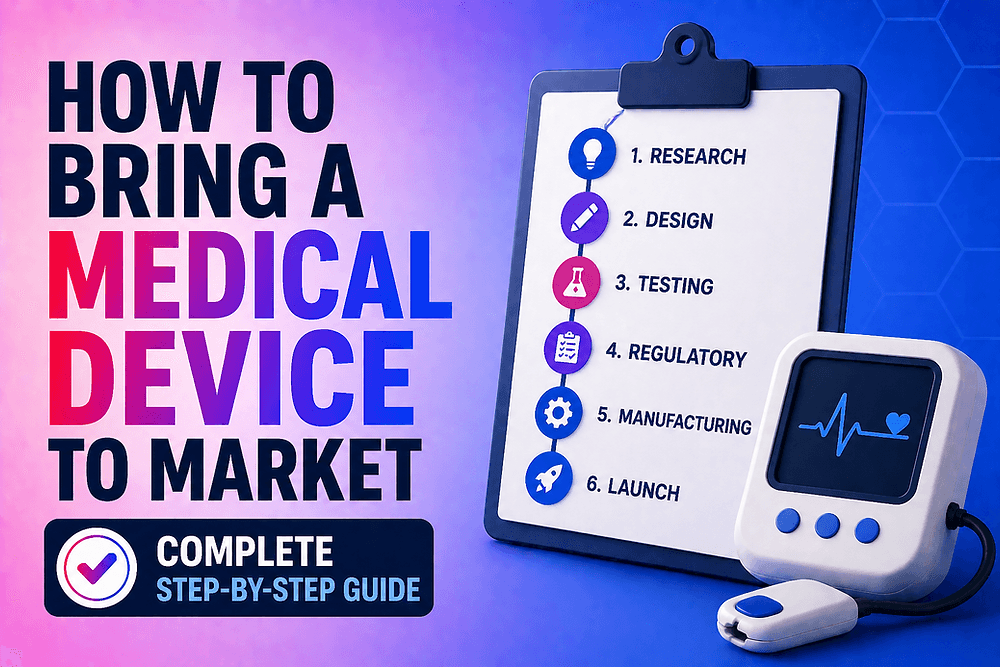
Medical device development runs from concept through design controls, verification and validation, clinical investigations when needed, and a potential US submission via 510(k), De Novo, or PMA. Concept to market typically spans about 3–7 years. Current FDA review goals are 510(k) 95% within 90 FDA days, De Novo 70% within 150 FDA days, and PMA average total time to decision ≈ 285–290 days (FY25–27). This guide breaks everything down step by step.
Medical Device Product Development Process Overview
Medical device product development is a highly regulated, multi-phase process that transforms innovative concepts into life-saving medical technologies. Unlike software, a medical device can’t ‘ship and patch.’ It must meet FDA safety-and-performance thresholds before first patient use—failures trigger recalls and patient risk.
Why Most Medical Device Development Projects Fail
Critical Success Factors:
- Strategic planning integration: Successful companies plan regulatory requirements, manufacturing, and commercialization from concept phase
- Phase gate discipline: Each development phase must meet specific criteria before advancing
- Risk management throughout: Continuous risk assessment prevents late-stage surprises
- Regulatory engagement early: FDA interaction programs can save months of development time
Common Failure Points:
- Underestimating regulatory complexity and timeline requirements
- Poor market research leading to products nobody wants
- Inadequate funding planning across all development phases
- Late-stage design changes due to regulatory or clinical issues
The 5-Phase Development Framework
Medical device product development follows a structured sequence designed to ensure safety, efficacy, and regulatory compliance:
Phase 1: Discovery & Concept Development (6-12 months)
Market research, needs assessment, concept validation, initial risk analysis
Phase 2: Design & Development (12-24 months)
Detailed design, prototyping, design controls implementation, engineering validation
Phase 3: Verification & Validation (6-18 months)
Testing protocols, clinical studies, design validation, risk management completion
Phase 4: Regulatory Submission (6-12 months)
FDA submission preparation, regulatory review, agency interactions
Phase 5: Manufacturing & Launch (6-12 months)
Scale-up manufacturing, quality system implementation, commercial launch
Phase 1: Discovery & Concept Development
The foundation phase where successful medical device product development projects are born—or doomed. This phase determines whether your concept has genuine market potential and technical feasibility.
Market Research & Needs Assessment
Unmet Clinical Need Identification: Start with genuine healthcare problems that lack adequate solutions. The most successful medical devices address clear, documented clinical needs with significant patient populations.
Market Size Analysis:
- Total Addressable Market (TAM): Most VCs look for a TAM north of US $300-500 M (or a path to > US $100 M annual revenue) before writing Series A cheques.
- Serviceable Addressable Market (SAM): Realistically capturable market share
- Competitive landscape mapping and differentiation analysis
User Research Requirements:
- Healthcare provider interviews and workflow analysis
- Patient journey mapping and pain point identification
- Key Opinion Leader (KOL) engagement and feedback collection
Concept Validation & Feasibility
Technical Feasibility Assessment:
- Engineering proof-of-concept development
- Materials science and manufacturing feasibility
- Technology readiness level (TRL) evaluation
- Intellectual property landscape analysis
Business Case Development:
- Revenue projections and business model validation
- Cost-to-manufacture estimates and pricing strategy
- Funding requirements across all development phases
- Go-to-market strategy and commercialization planning
Initial Risk Analysis
Risk Management Planning (ISO 14971):
- Hazard identification and risk estimation
- Risk control measures and residual risk assessment
- Risk management file establishment
- Post-market surveillance planning
Regulatory Strategy Development:
- FDA device classification determination
- Regulatory pathway selection (510(k), De Novo, PMA)
- International regulatory requirements assessment
- Clinical study planning and requirements
Key Deliverables & Success Criteria
Essential Phase 1 Outputs:
- Market research report with validated unmet need
- Technical feasibility study and proof-of-concept
- Business case with detailed financial projections
- Initial risk management plan and regulatory strategy
- Intellectual property filing and protection strategy
Phase Gate Criteria:
- Documented market need with quantified opportunity
- Technical feasibility demonstrated through proof-of-concept
- Viable business model with clear path to profitability
- Regulatory pathway identified with timeline estimates
- Funding secured for Phase 2 activities
Phase 2: Design & Development
The engineering-intensive phase where concepts become tangible medical devices. This phase establishes the foundation for all subsequent development activities through rigorous design controls.
Design Controls Implementation
Design Planning (21 CFR 820.30):
- Design and development plan creation
- Project timeline and milestone establishment
- Resource allocation and team assignment
- Design control procedures implementation
Design Inputs Definition:
- User needs and intended use specification
- Functional requirements and performance criteria
- Safety requirements and regulatory standards
- Design constraints and environmental conditions
Detailed Design & Engineering
Engineering Design Development:
- Mechanical, electrical, and software design specifications
- Materials selection and biocompatibility assessment
- Manufacturing process design and scalability analysis
- Component sourcing and supplier qualification
Prototyping Strategy:
- Rapid prototyping for concept validation
- Engineering prototypes for functional testing
- Clinical prototypes for verification testing
- Manufacturing prototypes for process validation
Design Risk Management
Risk Analysis Updates:
- Design hazard analysis and risk assessment
- Failure Mode and Effects Analysis (FMEA)
- Risk control measure implementation
- Residual risk evaluation and documentation
Design Verification Planning:
- Test protocol development and validation
- Acceptance criteria establishment
- Test method selection and validation
- Statistical analysis planning
Key Deliverables & Success Criteria
Essential Phase 2 Outputs:
- Complete design specifications and drawings
- Functional prototypes meeting design inputs
- Design verification protocols and procedures
- Updated risk management documentation
- Design History File (DHF) establishment
Phase Gate Criteria:
- Design meets all specified requirements
- Prototypes demonstrate intended functionality
- Risk analysis complete with acceptable risk levels
- Manufacturing feasibility confirmed
- Design verification protocols approved
Phase 3: Verification & Validation
The critical testing phase that proves your medical device works as intended and meets all safety and efficacy requirements. This phase generates the evidence needed for regulatory submission.
Design Verification Testing
Performance Testing Requirements:
- Bench testing to verify design specifications
- Biocompatibility testing per ISO 10993 standards
- Electrical safety testing per IEC 60601 standards
- Software validation per IEC 62304 requirements
Environmental Testing:
- Temperature and humidity testing
- Vibration and shock testing
- Electromagnetic compatibility (EMC) testing
- Packaging and sterilization validation
Clinical Evaluation & Studies
Clinical Study Planning:
- Clinical protocol development and statistical design
- Investigational Device Exemption (IDE) submission when required
- Clinical site selection and investigator training
- Institutional Review Board (IRB) approval process
Clinical Study Execution:
- Patient enrollment and data collection
- Adverse event monitoring and reporting
- Data quality assurance and monitoring
- Statistical analysis and clinical report preparation
Design Validation Activities
User Validation Testing:
- Human factors engineering (HFE) studies
- Usability testing in simulated use environments
- Clinical validation studies with intended users
- Label comprehension and user interface validation
Manufacturing Validation:
- Process validation and statistical process control
- Quality system implementation and validation
- Supplier qualification and component validation
- Packaging validation and shelf-life testing
Key Deliverables & Success Criteria
Essential Phase 3 Outputs:
- Complete verification and validation testing reports
- Clinical study reports and statistical analysis
- Human factors engineering study results
- Manufacturing process validation documentation
- Updated Design History File (DHF) with all testing data
Phase Gate Criteria:
- All verification testing passed with acceptable results
- Clinical studies demonstrate safety and efficacy
- Human factors testing confirms safe usability
- Manufacturing processes validated and qualified
- Regulatory submission documentation complete
Phase 4: Regulatory Submission
The regulatory approval phase where comprehensive documentation meets rigorous FDA review. Success requires strategic preparation and proactive agency engagement.
Regulatory Submission Preparation
510(k) Premarket Notification:
- Substantial equivalence demonstration to predicate devices
- Bench testing and clinical data compilation
- Labeling and user interface documentation
- Quality system summary and manufacturing information
Premarket Approval (PMA) Application:
- Comprehensive safety and effectiveness data
- Clinical study reports and statistical analysis
- Manufacturing information and quality system documentation
- Risk-benefit analysis and post-market study commitments
De Novo Classification Request:
- Novel device classification pathway for low-moderate risk devices
- Special controls development and implementation
- Clinical data requirements and study design
- Predicate establishment for future 510(k) submissions
FDA Interaction & Communication
Pre-Submission Meetings (Q-Sub):
- Regulatory strategy discussion and feedback
- Clinical study protocol review and agreement
- Testing protocol validation and acceptance criteria
- Special controls development for De Novo pathway
FDA Review Process Management:
- Submission tracking and communication management
- Additional Information Request (AIR) response preparation
- Panel meeting preparation when required
- Post-market commitment planning and implementation
International Regulatory Coordination
EU MDR Compliance:
- CE marking requirements and technical documentation
- Notified Body selection and assessment coordination
- Clinical evaluation and post-market clinical follow-up
- Unique Device Identification (UDI) implementation
Global Market Access:
- Health Canada medical device license application
- Japan PMDA consultation and approval process
- Other international regulatory requirements assessment
- Harmonized submission strategy development
Key Deliverables & Success Criteria
Essential Phase 4 Outputs:
- Complete regulatory submission documentation
- FDA clearance or approval letter
- International regulatory approvals as planned
- Post-market surveillance plan implementation
- Commercial labeling and user documentation
Phase Gate Criteria:
- FDA submission accepted for review
- All agency questions addressed satisfactorily
- Regulatory approval obtained within planned timeline
- International approvals secured for target markets
- Manufacturing ready for commercial launch
Phase 5: Manufacturing & Launch
The commercialization phase where approved medical devices transition from development to market reality. Success requires operational excellence and strategic market entry.
Manufacturing Scale-Up & Validation
Production System Implementation:
- Manufacturing facility qualification and validation
- Equipment installation, qualification, and calibration
- Personnel training and certification programs
- Supply chain establishment and supplier audits
Quality System Deployment:
- ISO 13485 quality management system implementation
- Design controls and document management systems
- Corrective and Preventive Action (CAPA) procedures
- Management review and continuous improvement processes
Commercial Launch Preparation
Market Entry Strategy:
- Sales team training and certification
- Marketing material development and regulatory review
- Key Opinion Leader (KOL) engagement and education
- Distribution channel establishment and training
Post-Market Surveillance:
- Adverse event reporting system implementation
- Customer complaint handling and investigation
- Post-market clinical studies when required
- Medical Device Reporting (MDR) compliance procedures
Business Operations & Growth
Commercial Operations:
- Customer service and technical support establishment
- Reimbursement strategy and coding assistance
- Health economics and outcomes research (HEOR)
- Competitive monitoring and market intelligence
Product Lifecycle Management:
- Product enhancement and iteration planning
- Next-generation product development initiation
- Market expansion and international launch planning
- Intellectual property portfolio expansion
Key Deliverables & Success Criteria
Essential Phase 5 Outputs:
- Validated commercial manufacturing operation
- Successful product launch with initial sales
- Functioning post-market surveillance system
- Established customer service and support operations
- Market feedback and product performance data
Phase Gate Criteria:
- Manufacturing processes validated and operational
- Initial commercial sales targets achieved
- Post-market surveillance system functional
- Customer satisfaction metrics meet targets
- Business case projections validated by market performance
Timeline Optimization Strategies
Early Integration Approach
Parallel Development Activities: Companies that succeed complete regulatory planning during design phases, conduct clinical studies during verification activities, and prepare manufacturing during validation phases.
Strategic Benefits:
- Reduced overall development timeline by 12-18 months
- Lower total development costs through efficient resource utilization
- Higher probability of regulatory approval through early agency engagement
- Faster time-to-market and competitive advantage
Risk-Based Development Planning
Phase Gate Discipline: Implement rigorous phase gate reviews with specific go/no-go criteria. Failed phase gates require remediation before advancement, preventing expensive late-stage failures.
Risk Mitigation Strategies:
- Continuous risk assessment and management throughout development
- Early identification and resolution of technical challenges
- Proactive regulatory engagement and feedback incorporation
- Contingency planning for critical path activities
Resource Optimization Tactics
Strategic Outsourcing:
- Partner with experienced contract research organizations (CROs)
- Leverage contract manufacturing expertise for scale-up
- Utilize regulatory consulting for complex submissions
- Access specialized testing laboratories for validation
Internal Capability Building:
- Invest in regulatory affairs and quality assurance expertise
- Develop clinical research and data management capabilities
- Build manufacturing and supply chain competencies
- Establish business development and commercial operations
Common Development Failures (And How to Avoid Them)
Market & Business Failures
Problem: Building solutions for non-existent problems
Impact: 42% of startup failures attributed to market need issues
Solution: Extensive user research and market validation before significant investment
Problem: Underestimating total funding requirements
Impact: Development stalls due to inadequate capital, leading to project failure
Solution: Conservative financial planning with 50% contingency for unexpected costs
Technical & Regulatory Failures
Problem: Late-stage regulatory surprises and requirements
Impact: Expensive redesigns and extended timelines
Solution: Early FDA engagement through Q-Submission program and regulatory consulting
Problem: Inadequate risk management and testing protocols
Impact: Failed verification/validation leading to regulatory rejection
Solution: Comprehensive risk analysis and robust testing protocol development
Operational & Management Failures
Problem: Poor project management and phase gate discipline
Impact: Scope creep, timeline delays, and budget overruns
Solution: Rigorous project management with clear phase gate criteria and accountability
Problem: Inadequate team expertise and capability gaps
Impact: Poor execution and missed critical requirements
Solution: Strategic hiring, training, and partnership with experienced development partners
Industry Trends Affecting Development
Technology Integration Trends
Artificial Intelligence & Machine Learning: AI integration reducing development timelines through predictive analytics, automated testing, and enhanced clinical trial efficiency. AI-powered devices require additional regulatory considerations and validation approaches.
Connected Device Requirements: Increasing demand for interoperability with Electronic Health Records (EHRs) and healthcare IT systems. Cybersecurity requirements becoming critical regulatory focus with FDA guidance evolution.
Regulatory Environment Changes
Enhanced Digital Health Guidance: FDA expanding digital health pathways and Software as Medical Device (SaMD) regulations. New guidance on AI/ML-based devices and predetermined change control plans.
International Harmonization Efforts: Increasing coordination between FDA, EU MDR, and other global regulatory bodies. Opportunities for streamlined international submissions and reduced duplicate requirements.
Market & Commercial Trends
Value-Based Healthcare: Growing emphasis on health economics and outcomes research (HEOR). Reimbursement requirements driving clinical evidence generation and real-world data collection.
Supply Chain Resilience: Post-pandemic focus on supply chain diversification and resilience. Manufacturing reshoring and nearshoring trends affecting development and commercialization strategies.
Implementation Roadmap for Your Development Project
Months 1-6: Foundation Phase
Market & Concept Validation:
- Conduct comprehensive market research and user needs analysis
- Develop business case and funding strategy
- Complete technical feasibility assessment and proof-of-concept
- Establish intellectual property protection strategy
Team & Infrastructure:
- Assemble core development team with necessary expertise
- Establish project management systems and phase gate processes
- Select key development partners and service providers
- Implement quality management system foundation
Months 7-18: Design & Engineering Phase
Design Development:
- Complete detailed design specifications and engineering
- Develop functional prototypes and conduct initial testing
- Implement design controls and documentation systems
- Conduct preliminary risk analysis and regulatory planning
Regulatory Preparation:
- Determine regulatory pathway and submission requirements
- Schedule FDA Q-Submission meetings for strategy validation
- Begin clinical study planning and protocol development
- Prepare for verification and validation testing phases
Months 19-36: Testing & Validation Phase
Comprehensive Testing:
- Execute design verification and validation protocols
- Conduct clinical studies and collect safety/efficacy data
- Complete human factors engineering and usability studies
- Finalize risk management and post-market surveillance planning
Regulatory Submission:
- Prepare and submit FDA application (510(k), De Novo, or PMA)
- Respond to agency questions and maintain communication
- Coordinate international regulatory submissions as planned
- Prepare for commercial launch and manufacturing scale-up
Months 37-48: Launch & Commercialization Phase
Manufacturing & Launch:
- Complete manufacturing scale-up and process validation
- Implement commercial quality system and operations
- Execute market launch and initial commercialization
- Establish post-market surveillance and customer support
Business Growth:
- Monitor market performance and customer feedback
- Plan product enhancements and next-generation development
- Expand market access and international opportunities
- Build sustainable business operations and growth strategy
Ready to Navigate Medical Device Product Development Successfully?
Medical device product development is complex, but companies that understand the process and plan strategically achieve remarkable success. The difference between the 25% that succeed and the 75% that fail often comes down to early planning, regulatory engagement, and disciplined execution.
Smart medtech companies partner with experienced development experts who understand both the technical and regulatory requirements for bringing life-saving innovations to market.
The Fastest Path to Market
No more guesswork. Move from research to a defendable FDA strategy, faster. Backed by FDA sources. Teams report 12 hours saved weekly.
Frequently Asked Questions
How long does medical device product development actually take?
Development timelines vary significantly: Class I devices (1-3 years), Class II devices (3-5 years), Class III devices (5-7+ years). Timeline depends on device complexity, regulatory pathway, and clinical requirements.
What's the biggest cause of development delays?
Regulatory surprises and inadequate planning cause the most delays. Early FDA engagement and comprehensive regulatory strategy can prevent 60-80% of common delay causes.
How much should we budget for medical device product development?
Development costs range from $500K for simple Class I devices to $100M+ for complex Class III devices. Budget 25-30% contingency for unexpected costs and timeline extensions.
When should we start regulatory planning?
Begin regulatory strategy development in Phase 1 (concept development). Early regulatory engagement through FDA Q-Submissions can save 6-12 months in development timeline.
What's the most critical success factor for development projects?
Strong project management with rigorous phase gate discipline. Clear success criteria and go/no-go decisions prevent expensive late-stage failures and budget overruns.