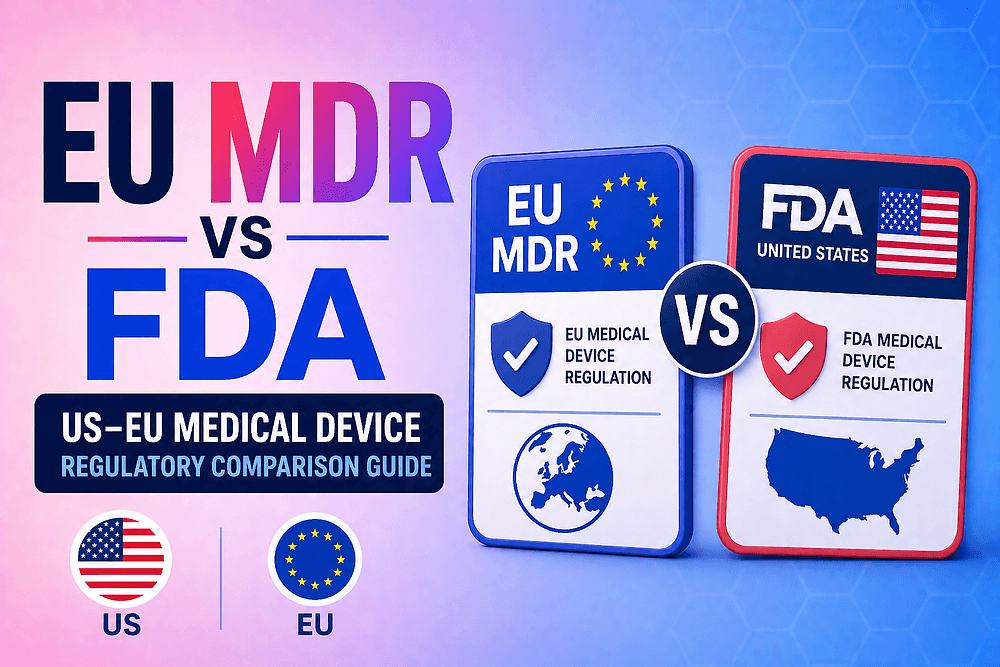
Medical device companies expanding globally face a critical strategic decision: which regulatory pathway offers the fastest, most cost-effective route to market? EU MDR typically requires 12-18 months and $500K-$2M for CE marking through Notified Body assessment, while FDA 510(k) averages 6-12 months and $1M-$6M but offers faster market access. EU MDR provides broader global market acceptance (27 EU countries + many international markets), while FDA 510(k) is primarily US-focused. Most successful companies pursue both markets sequentially, starting with their primary market then leveraging that approval for the second market.
The companies that understand both regulatory systems and choose the optimal market entry sequence will capture market share while competitors struggle with compliance delays.
The Global Medical Device Market Reality: Why Both Markets Matter
The global medical device market is valued at $640.45 billion in 2024, with the EU representing approximately $160 billion and the US $180 billion. However, the strategic value goes beyond market size—regulatory approval in one market often facilitates entry into additional markets worldwide.
Market Access Implications:
- EU MDR CE marking: CE is mandatory across the EEA (30 countries: EU-27 + Iceland, Liechtenstein, Norway)
- FDA 510(k) clearance: Primarily US market access, with limited direct recognition in other markets
- Dual approval strategy: Opens both markets plus provides credibility for additional international expansion
The Strategic Reality: Companies that master both regulatory systems can dominate global markets, while those limited to one system miss massive revenue opportunities.
Regulatory Framework Comparison: Structure and Philosophy
FDA Regulatory Approach
The FDA's regulatory framework is codified in 21 CFR (Code of Federal Regulations) and operates under the Federal Food, Drug, and Cosmetic Act. The system is designed around risk-based device classification with specific pathways for market entry.
Key Characteristics:
- Centralized Review: Single federal agency (FDA) reviews all submissions
- Predicate-Based: 510(k) pathway relies on demonstrating substantial equivalence to existing devices
- Risk-Based Classification: Class I (low risk), Class II (moderate risk), Class III (high risk)
- Market-Specific Focus: Primarily designed for US market access
EU MDR Regulatory Approach
The EU Medical Device Regulation (EU) 2017/745 replaced the Medical Device Directive (MDD) on May 26, 2021. The system operates through Notified Bodies designated by individual EU member states.
Key Characteristics:
- Decentralized System: Multiple Notified Bodies across EU member states
- Performance-Based: MDR requires conformity to the General Safety & Performance Requirements (GSPRs, Annex I) plus clinical evaluation
- Rule-Based Classification: 22 classification rules determine device class (I, IIa, IIb, III)
- Global Market Access: CE marking grants access across the EEA (EU-27 + Iceland, Liechtenstein, Norway)
Device Classification Systems: Critical Differences
FDA Classification System
Class
Risk Level
Examples
Regulatory Path
Class I
Low
Bandages, tongue depressors
510(k) exempt (most)
Class II
Moderate
Infusion pumps, ultrasound
510(k) required
Class III
High
Pacemakers, heart valves
PMA required
Classification Drivers:
- Intended use and indications for use
- Degree of risk to patient and user
- Regulatory controls needed to ensure safety and effectiveness
EU MDR Classification System
Class
Risk Level
Examples
Notified Body Required
Class I
Low
Stethoscopes, wheelchairs
No, unless Is/Im/Ir (sterile, measuring, reusable surgical)
Class II a
Low-Medium
Hearing aids, ultrasonic cleaners
Yes
Class II b
Medium-High
Ventilators, surgical lasers
Yes
Class III
High
Heart valves, breast implants
Yes
Classification Drivers:
- 22 specific rules based on invasiveness, duration of contact, and body system affected
- Active vs. non-active device distinction
- Software-specific classification rules
Critical Insight: The same device may receive different classifications under FDA vs EU MDR, affecting regulatory requirements and timelines significantly.
Market Entry Pathways: Process and Requirements
FDA 510(k) Pathway(Most Common)
Process Overview:
- Pre-Submission Meeting (Optional but recommended)
- 510(k) Submission Preparation (3-6 months)
- FDA Review (90 days standard, often extended)
- Response to FDA Questions (Additional time if needed)
- Clearance Letter (Marketing authorization)
Core Requirements:
- Substantial Equivalence: Demonstrate device is as safe and effective as predicate device
- Predicate Device Identification: Legally marketed device with same intended use
- Performance Testing: Bench testing, biocompatibility, software validation
- Clinical Data: Clinical data is sometimes required when non-clinical testing can’t show SE (e.g., new tech/indications)
Key Documents:
- Device description and intended use
- Substantial equivalence comparison
- Performance testing data
- Software documentation (if applicable)
- Labeling and instructions for use
EU MDR CE Marking Pathway
Process Overview:
- Device Classification (Using 22 classification rules)
- Quality Management System (ISO 13485 implementation)
- Technical Documentation (Annexes II and III compliance)
- Notified Body Selection and Application
- Conformity Assessment (Audit and review process)
- CE Certificate Issuance
- EU Declaration of Conformity
Core Requirements:
- General Safety and Performance Requirements (GSPRs): Comprehensive safety checklist
- Clinical Evaluation: Literature review or clinical investigation required
- Risk Management: ISO 14971 compliance mandatory
- Post-Market Surveillance: Detailed plan required
- Person Responsible for Regulatory Compliance (PRRC): Designated individual required
Key Documents:
- Technical documentation (comprehensive device file)
- Clinical evaluation report (CER)
- Risk management file
- Post-market surveillance plan
- Quality management system documentation
Clinical Evidence Requirements: The Key Differentiator
FDA Clinical Evidence Requirements
510(k) Clinical Data:
- Predicate Comparison: If substantial equivalence can be demonstrated through performance testing, clinical data often not required
- Significant technological differences from predicate
- New intended use not previously cleared
- Safety and effectiveness questions remain
Clinical Study Types:
- Pivotal clinical trials (randomized controlled trials)
- Real-world evidence studies (increasingly accepted)
- Literature-based evidence (limited acceptance)
EU MDR Clinical Evidence Requirements
Clinical Evaluation Mandatory:
- Always Required: Every device must have clinical evaluation regardless of classification
- Clinical Evaluation Report (CER): Comprehensive analysis required for all devices
Clinical Evidence Sources:
- Clinical Investigation: Original clinical studies
- Equivalence Data: From equivalent devices (with strict equivalence criteria)
- Literature Review: Systematic review of published data
- Post-Market Clinical Follow-up (PMCF): Ongoing data collection required
Equivalence Requirements (Stricter than FDA):
- Same intended purpose and clinical condition
- Similar design and technical characteristics
- Similar biological interaction with human body
- Same risk profile and clinical management
Key Difference: EU MDR's clinical evaluation requirements are significantly more stringent than FDA 510(k), often requiring fresh clinical data even when FDA accepted predicate-based clearance.
Quality Management System Requirements
FDA QMS Requirements (21 CFR 820)
Current System (Transitioning to QMSR):
- Design Controls: Required for Class II and III devices
- Document Controls: Comprehensive documentation system
- Management Responsibility: Quality policy and objectives
- Corrective and Preventive Actions (CAPA): Systematic approach to quality issues
2026 QMSR Transition:
- ISO 13485:2016 Alignment: New Quality Management System Regulation incorporates ISO 13485:2016
- Effective Date: February 2, 2026
- Harmonization Benefit: Closer alignment with EU MDR requirements
EU MDR QMS Requirements
ISO 13485:2016 Compliance:
- Legal Basis: MDR Article 10 requires a proportionate, documented QMS.
- Notified Body Audit: QMS audit required for Class IIa, IIb, and III devices
- PRRC Requirement: Person Responsible for Regulatory Compliance must be designated
- Risk Management Integration: ISO 14971 implementation mandatory
Post-Market Requirements:
- Post-Market Surveillance (PMS): Detailed plan and implementation required
- Vigilance Reporting: Serious incidents must be reported
- Periodic Safety Update Reports (PSUR): Regular safety assessments required
Strategic Advantage: Companies implementing ISO 13485:2016 now will be ahead of the curve for both markets after the 2026 FDA QMSR transition.
Market Entry Strategy Comparison
When to Choose FDA First
Optimal Scenarios:
- Primary Market: US represents majority of target market revenue
- Predicate Available: Clear predicate device exists for 510(k) pathway
- Speed Critical: Need fastest possible market entry
- Limited Clinical Data: Minimal clinical evidence available
- Resource Constraints: Limited budget for comprehensive clinical evaluation
Strategic Benefits:
- Faster Revenue: Quicker path to commercial sales
- Market Validation: US market success validates global strategy
- Investment Attraction: FDA clearance attracts US investors and strategic partners
- Regulatory Credibility: FDA clearance provides global regulatory credibility
When to Choose EU MDR First
Optimal Scenarios:
- Global Strategy: Targeting multiple international markets beyond US
- Strong Clinical Data: Robust clinical evidence already available
- Long-term Vision: Building comprehensive regulatory portfolio
- Manufacturing Location: European-based manufacturing or operations
- Reimbursement Strategy: EU health technology assessment familiarity
Strategic Benefits:
- Broader Market Access: CE Mark = EEA access (EU-27 + Iceland, Liechtenstein, Norway).
- Regulatory Foundation: Comprehensive clinical evaluation supports future submissions
- International Credibility: CE marking widely recognized globally
- Harmonization Advantage: Aligns with many international regulatory systems
Post-Market Requirements: Ongoing Compliance
FDA Post-Market Obligations
Medical Device Reporting (MDR):
- Adverse Event Reporting: report deaths, serious injuries and certain malfunctions
- Malfunction Reporting: 30 days for device malfunctions
- Annual Reports (PMA): Device experience and adverse event summaries
Quality System Inspections:
- Unannounced Inspections: FDA can inspect facilities without notice
- Biennial Inspections: Most facilities inspected every 2 years
- Risk-Based Approach: High-risk devices inspected more frequently
Change Control:
- 510(k) Modifications: New 510(k) required for significant changes
- Change Evaluation: Detailed analysis required for all modifications
EU MDR Post-Market Obligations
Vigilance System:
- Serious Incident Reporting: Immediate reporting to competent authorities
- Field Safety Corrective Actions (FSCA): Systematic approach to safety issues
- Trend Reporting: Proactive identification of safety trends
Post-Market Surveillance:
- PMS Plan Implementation: Active surveillance required
- PMCF Studies: Post-market clinical follow-up for high-risk devices
- PSUR Updates: Periodic safety update reports required
EUDAMED Registration:
- Device Registration: All devices must be registered in EUDAMED database
- UDI Implementation: Unique device identification system mandatory
- Transparency Requirements: Public access to device information
Cost-Benefit Analysis: 5-Year Market Impact
Single Market Strategy Limitations
FDA-Only Approach:
- Market Limitation: US market only (~28% of global medical device market)
- Competitive Disadvantage: EU competitors can access broader markets
- Investment Concerns: Limited global expansion potential may deter investors
- Regulatory Risk: Single-market dependency creates vulnerability
EU MDR-Only Approach:
- US Market Loss: Missing largest single medical device market
- Revenue Impact: Potential 45–55% revenue reduction vs dual-market strategy
- Competitive Risk: US-based competitors have domestic market advantage
- Reimbursement Challenges: US payer systems may prefer FDA-cleared devices
Dual-Market Strategy Benefits
Revenue Optimization:
- Market Coverage: Access to 65%+ of global medical device spending
- Risk Diversification: Reduced dependence on single regulatory environment
- Competitive Advantage: Few companies execute both markets effectively
- Strategic Partnerships: Dual approval attracts global distribution partners
Cost Optimization:
- Regulatory Synergies: ISO 13485 compliance supports both markets
- Clinical Data Leverage: EU clinical evaluation can support FDA submissions
- Development Efficiency: Parallel development reduces time to global market
- Harmonization Benefits: 2026 FDA QMSR alignment reduces compliance burden
Strategic Market Entry Sequencing
Sequence 1: FDA First, Then EU MDR
Optimal For:
- US-focused companies with limited international experience
- Devices with clear FDA predicates but uncertain EU classification
- Companies needing quick revenue generation
- Startups requiring FDA clearance for investment rounds
Implementation Strategy:
- Phase 1 (Months 1-12): FDA 510(k) clearance and US market launch
- Phase 2 (Months 6-18): ISO 13485 implementation and EU gap analysis
- Phase 3 (Months 12-30): EU MDR submission and CE marking
- Phase 4 (Months 24-36): EU market entry and global expansion
Advantages:
- Fast US revenue generation funds EU expansion
- FDA clearance provides regulatory credibility for EU submission
- US clinical experience supports EU clinical evaluation
- Staggered investment reduces cash flow pressure
Sequence 2: EU MDR First, Then FDA
Optimal For:
- International companies targeting global markets
- Devices requiring significant clinical evaluation
- Companies with strong clinical data foundation
- EU-based manufacturers or operations
Implementation Strategy:
- Phase 1 (Months 1-18): EU MDR compliance and CE marking
- Phase 2 (Months 12-24): EU market launch and clinical data collection
- Phase 3 (Months 18-30): FDA predicate identification and 510(k) preparation
- Phase 4 (Months 24-36): FDA submission and US market entry
Advantages:
- Comprehensive clinical evaluation supports FDA submission
- EU revenue generation funds US expansion
- Broader initial market access (27+ countries)
- Strong regulatory foundation for additional markets
Sequence 3: Parallel Development (Advanced Strategy)
Optimal For:
- Well-funded companies with experienced regulatory teams
- Devices suitable for both markets with minimal adaptation
- Companies needing rapid global market access
- Strategic situations requiring simultaneous launches
Implementation Strategy:
- Months 1-6: Parallel regulatory strategy development
- Months 6-18: Simultaneous FDA and EU submissions
- Months 18-24: Parallel regulatory reviews and responses
- Months 24-30: Coordinated global market launch
Resource Requirements:
- Dual regulatory teams or comprehensive consulting support
- Significant capital investment ($2M-$5M regulatory budget)
- Advanced project management capabilities
- Strong clinical and quality management foundation
Regulatory Harmonization Opportunities
ISO 13485:2016 as Universal Foundation
Harmonization Benefits:
- Single QMS: One quality system supports both markets
- Reduced Duplication: Shared documentation and processes
- 2026 Alignment: FDA QMSR adoption creates greater harmony
- Global Compatibility: Foundation for additional international markets
Implementation Strategy:
- Implement ISO 13485:2016 with FDA and EU MDR-specific procedures
- Design risk management system meeting both ISO 14971 and FDA requirements
- Create integrated documentation system supporting both submissions
- Establish unified post-market surveillance covering both markets
Shared Technical Documentation
Common Elements:
- Device Description: Core technical specifications
- Risk Management: ISO 14971 compliant risk analysis
- Software Documentation: IEC 62304 compliance for both markets
- Biocompatibility Testing: ISO 10993 testing accepted by both
- Electromagnetic Compatibility: Shared EMC testing requirements
Market-Specific Requirements:
- Clinical Evidence: Different standards and expectations
- Labeling Requirements: Distinct formatting and content requirements
- Post-Market Obligations: Different reporting and surveillance systems
- Change Control: Varying requirements for modification management
Common Pitfalls and How to Avoid Them
FDA-Specific Pitfalls
Predicate Selection Errors:
- Problem: Choosing inappropriate or weak predicate devices
- Solution: Conduct thorough predicate analysis with regulatory expertise
- Impact: Can lead to additional clinical data requirements or submission rejection
Substantial Equivalence Gaps:
- Problem: Underestimating differences between device and predicate
- Solution: Early FDA Pre-Submission meetings to clarify regulatory expectations
- Impact: Extended review timelines and additional testing requirements
Change Control Failures:
- Problem: Making device changes without assessing 510(k) requirements
- Solution: Implement robust change control procedures with regulatory review
- Impact: FDA enforcement actions and marketing restrictions
EU MDR-Specific Pitfalls
Clinical Evaluation Inadequacy:
- Problem: Insufficient clinical evidence or poor equivalence justification
- Solution: Engage clinical evaluation specialists early in development
- Impact: Notified Body rejection and requirement for additional clinical studies
Notified Body Capacity Issues:
- Problem: Limited Notified Body availability and extended review times
- Solution: Early Notified Body engagement and realistic timeline planning
- Impact: Significant delays in CE marking and market entry
PRRC Qualification Gaps:
- Problem: Appointing unqualified Person Responsible for Regulatory Compliance
- Solution: Ensure PRRC meets specific education and experience requirements
- Impact: Notified Body audit failures and compliance violations
Dual-Market Strategy Pitfalls
Resource Overextension:
- Problem: Attempting parallel development without adequate resources
- Solution: Realistic resource planning and phased approach consideration
- Impact: Quality compromises and regulatory failures in both markets
Regulatory Strategy Conflicts:
- Problem: Design decisions optimized for one market that complicate the other
- Solution: Integrated regulatory strategy from early development stages
- Impact: Increased development costs and extended timelines
Change Control Complexity:
- Problem: Managing modifications across different regulatory requirements
- Solution: Unified change control system addressing both markets
- Impact: Compliance violations and market restrictions
Future Regulatory Trends: 2025-2030 Outlook
FDA Regulatory Evolution
Quality Management System Regulation (QMSR):
- Implementation Date: February 2, 2026
- ISO 13485:2016 Adoption: Harmonization with international standards
- Impact: Closer alignment with EU MDR requirements
Digital Health Advancement:
- Software as Medical Device (SaMD): Enhanced guidance and pathways
- AI/ML Frameworks: Specific requirements for artificial intelligence devices
- Real-World Evidence: Increased acceptance of post-market data
Streamlined Pathways:
- De Novo Enhancement: Improved pathway for novel devices
- Breakthrough Device Program: Expedited review for innovative technologies
- Predetermined Change Control Plans: Proactive modification management
EU MDR Regulatory Evolution
Implementation Challenges Resolution:
- Notified Body Capacity: Increased capacity and improved efficiency
- EUDAMED Full Functionality: Complete database implementation by Q4 2025
- Guidance Clarification: Continued MDCG guidance development
AI Act Integration:
- Artificial Intelligence Regulation: Overlap with medical device requirements
- High-Risk AI Systems: Additional requirements for AI-based medical devices
- Conformity Assessment: Enhanced scrutiny for AI-enabled devices
Global Harmonization:
- IMDRF Alignment: Increased international harmonization efforts
- Mutual Recognition: Potential agreements with other regulatory authorities
- Digital Submissions: Enhanced electronic submission capabilities
Strategic Implications
Convergence Opportunities:
- Harmonized Standards: Continued alignment of technical requirements
- Mutual Recognition Potential: Possible future regulatory cooperation agreements
- Shared Best Practices: Cross-market learning and optimization
Competitive Advantages:
- Early Adopters: Companies mastering both systems gain sustainable advantages
- Regulatory Expertise: Deep dual-market knowledge becomes competitive differentiator
- Global Strategy: Integrated approach enables rapid international expansion
The Fastest Path to Market
No more guesswork. Move from research to a defendable FDA strategy, faster. Backed by FDA sources. Teams report 12 hours saved weekly.
Frequently Asked Questions
Q: Can I use my FDA 510(k) clearance to get EU MDR approval faster?
FDA clearance provides credibility but doesn't significantly accelerate EU MDR approval. EU requires independent clinical evaluation and compliance demonstration, though FDA data can support the clinical evaluation report.
Q: Which regulatory path is more expensive overall?
FDA 510(k) typically has higher upfront costs ($1-6M) while EU MDR has ongoing costs that can reach 5% of sales. Total cost depends on device complexity and company size.
Q: How will the 2026 FDA QMSR change affect dual-market strategies?
The QMSR adoption of ISO 13485:2016 will significantly harmonize quality system requirements, making dual-market compliance easier and more cost-effective.
Q: Should I choose the same Notified Body for multiple devices?
Generally yes, as established relationships improve efficiency and consistency. However, consider capacity, expertise, and timeline requirements for each specific device.
Q: Can I market my device globally with just EU MDR approval?
CE marking is accepted in 50+ countries beyond the EU, but major markets like US, Canada, and Japan require separate approvals. EU MDR provides the broadest initial global access.